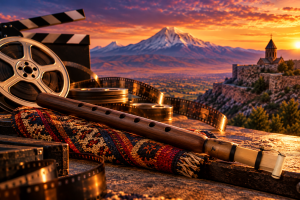
What Famous Movies Feature Duduk Music? The Armenian Duduk in Film Soundtracks
Many people discover the Armenian duduk without realizing what they are hearing. A film reaches a quiet, emotional moment and a warm woodwind voice appears above the orchestra. It sounds ancient but intimate, distant but remarkably human. The viewer may remember the sound for years without ever knowing the name of the instrument that produced it.
That instrument is often the duduk.
The Armenian duduk has travelled remarkably far from its traditional musical environment. While it remains deeply connected to Armenian culture and musical heritage, its distinctive timbre has also become part of the international language of film scoring. During the last several decades, composers and musicians have brought the instrument into major Hollywood productions, historical dramas, thrillers, fantasy films, and other cinematic worlds.
The story of the duduk in movies is particularly interesting because cinema did more than simply borrow another unusual instrument. Film introduced millions of listeners to a sound they might otherwise never have encountered. For some audiences outside Armenia, hearing the duduk in a movie became their first step toward discovering the instrument itself.
Among the musicians responsible for that expansion, one name is impossible to ignore: Djivan Gasparyan. His work brought the Armenian duduk to an enormous international audience, and his collaborations with composers helped establish the instrument as a recognizable color within contemporary film music.
But Gladiator is only one part of that story.
The duduk can be heard across a surprisingly varied collection of scores, including The Crow, The Last Temptation of Christ, Syriana, Blood Diamond, The Passion of the Christ, The Chronicles of Narnia, Dune, and other productions.
Understanding why composers repeatedly choose this instrument reveals something important about the duduk itself: its sound can communicate emotion even when the listener knows absolutely nothing about its history.
If this is your first introduction to the instrument, start with What Is a Duduk? to understand how this traditional Armenian double-reed instrument produces its distinctive sound.
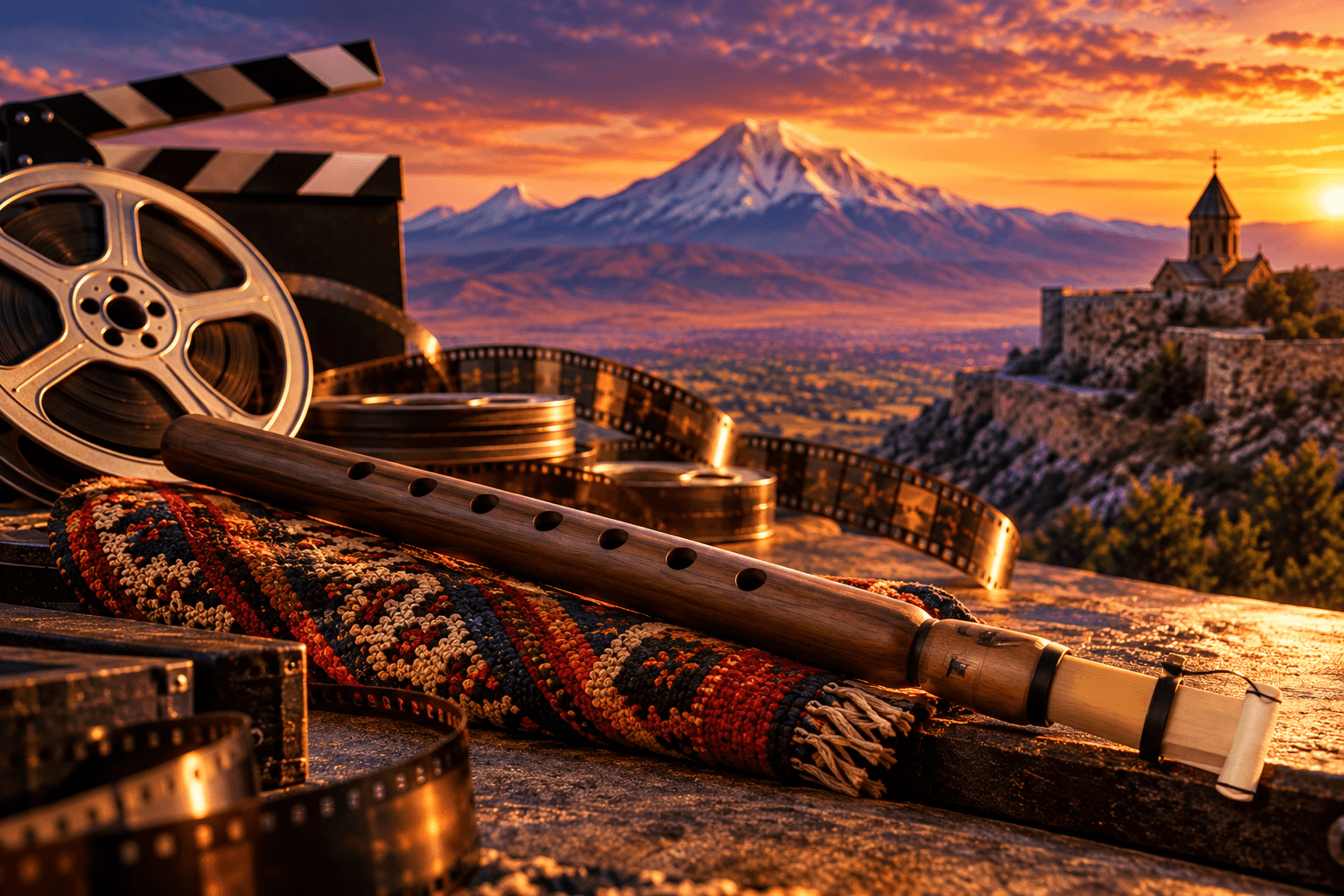
Why Do Film Composers Use the Duduk?
Film composers have access to almost every instrument imaginable. A major production can combine a symphony orchestra, electronic sound design, voices, percussion from multiple traditions, rare acoustic instruments, and digitally manipulated sounds. The decision to use a duduk is therefore rarely about simply adding another woodwind to the orchestra.
The duduk has a tonal identity that is difficult to reproduce with conventional orchestral instruments. Its large double reed produces a warm, slightly nasal, breath-rich tone capable of sounding remarkably close to a human voice. It can be fragile and intimate in one phrase and intense in the next without needing enormous volume. This makes it particularly effective when a composer wants a solo instrumental line to feel personal rather than purely orchestral.
Hans Zimmer’s comments about working with Djivan Gasparyan on Gladiator help explain the attraction. Zimmer described Gasparyan’s playing as having a lonely and haunting quality and explained that he had wanted to write for the Armenian musician specifically. The combination of an ancient-sounding acoustic voice with a large modern film orchestra created a contrast that became one of the score’s distinctive characteristics.
That quality also explains why the duduk appears in films that have very little direct connection to Armenia. Filmmakers have used its sound to suggest memory, solitude, grief, spirituality, geographical distance, or an ancient world. Sometimes that works beautifully as musical storytelling. At other times, it reflects Hollywood’s broader tendency to use the duduk as a generalized sonic symbol for places and cultures far beyond Armenia.
That distinction is worth remembering. The duduk is not simply a generic “desert instrument” or interchangeable Middle Eastern sound. It is an instrument with a specific and important Armenian musical identity.
You can explore that identity more deeply in our guide to the Armenian Duduk.
The Last Temptation of Christ (1988): An Important Moment for Duduk in International Cinema
Long before Gladiator introduced another generation of moviegoers to the sound of the duduk, Peter Gabriel was exploring an extraordinary collection of traditional instruments and musicians for Martin Scorsese’s The Last Temptation of Christ.
Released in 1988, the film’s score became an important point in the international exposure of the duduk. Gabriel’s work incorporated musical influences and performers from multiple traditions rather than relying exclusively on a conventional Western orchestral language. The duduk became part of that sonic world.
The Armenian musician Vatche Hovsepian is associated with the duduk performance in the score. Gabriel’s encounter with the instrument also contributed to a longer relationship with Armenian duduk music and, later, Djivan Gasparyan.
What makes this example important is the date. When people discuss duduk in Hollywood, Gladiator is frequently treated as the beginning of the story because of the enormous popularity of that film and soundtrack. But the instrument had already entered significant international film scoring before 2000.
The Last Temptation of Christ helped demonstrate that the duduk could function outside a strictly Armenian musical setting while retaining the expressive qualities that made it distinctive in the first place.
That opened a door that later composers would continue to explore.
The Crow (1994): Djivan Gasparyan’s Duduk in a Dark Cinematic World
The 1994 film The Crow, directed by Alex Proyas, offers another documented example of the duduk entering a major film score before Gladiator. The score was composed by Graeme Revell, and the official soundtrack credits identify Djivan Gasparyan on duduk.
This is a particularly interesting use of the instrument because The Crow is not a historical epic and is not set in Armenia or the Middle East. Its world is dark, urban, gothic, supernatural, and emotionally centered on loss.
That context demonstrates something essential about the duduk’s cinematic potential.
The instrument does not need to represent geography.
It can represent emotion.
Placed within an atmospheric score, the duduk’s breathy and vulnerable quality can exist alongside electronic textures, percussion, orchestration, and darker sonic elements without losing its identity. Rather than functioning merely as an ethnic marker, it becomes an emotional voice inside the larger score.
This ability to work in very different musical environments would become increasingly important as more composers began incorporating the duduk into films with no Armenian setting at all.
Gladiator (2000): The Duduk Reaches a Massive Global Audience
For many listeners around the world, the connection between duduk and movies begins with one film: Ridley Scott’s Gladiator.
The score, composed by Hans Zimmer and Lisa Gerrard, became enormously influential, and Armenian master Djivan Gasparyan contributed duduk to the musical world surrounding the film. Zimmer had specifically wanted to work with Gasparyan and later spoke enthusiastically about the musician and the distinctive quality of his sound.
Gasparyan himself discussed the collaboration and confirmed that music had been written for duduk for the project. His playing appears on the soundtrack, where the instrument contributes a sound dramatically different from the enormous orchestral and percussion textures heard elsewhere in the score.
This contrast is one of the reasons the duduk works so effectively in cinematic music. A full orchestra can communicate enormous scale, but a solo duduk can suddenly reduce the emotional distance between the story and the audience. The music can move from spectacle to something that feels personal without abandoning the larger musical identity of the film.
The international success of Gladiator gave the instrument unprecedented exposure. Audiences who had never heard the word “duduk” were suddenly listening to one of its greatest modern performers within one of the most widely heard film scores of its era.
For Gasparyan, the project became one of the best-known international collaborations of his career. For the duduk, it helped establish a place within the vocabulary of major contemporary film scoring.
Why Djivan Gasparyan Was So Important to the Duduk’s Cinematic Story
It would be difficult to discuss duduk in cinema without repeatedly returning to Djivan Gasparyan because his influence extends far beyond a single soundtrack. He did not simply provide an unusual instrumental color for composers. His playing introduced international listeners to a highly developed Armenian performance tradition.
Gasparyan had already built an extraordinary musical career before Hollywood embraced the instrument. His collaborations outside Armenia expanded his audience, and film composers discovered that his duduk could sit alongside Western orchestration while maintaining a completely distinctive voice.
After Gladiator, his film work continued. Credits and recording documentation connect him with projects including Syriana and Blood Diamond, while his earlier appearance on The Crow demonstrates that his cinematic work had begun before the enormous visibility created by Zimmer’s score.
His influence also helped make the word duduk more recognizable within the international music industry. Once composers, orchestrators, producers, and audiences became familiar with the instrument, other duduk specialists could bring it into additional productions.
In that sense, Gasparyan did more than perform on famous soundtracks.
He helped change the international visibility of the instrument itself.
The Passion of the Christ (2004): Duduk Inside a Large World-Music Palette
John Debney’s score for The Passion of the Christ incorporated a wide range of orchestral, vocal, and traditional instrumental colors. The duduk was among the instruments used in the score, with Chris Bleth credited on duduk and Pedro Eustache among the woodwind performers.
The soundtrack demonstrates how composers can use the duduk as part of a broader sonic palette rather than always making it the dominant solo instrument. Duduk appears alongside voices, orchestra, percussion, bamboo flute, oud, erhu, and other distinctive timbres.
This is important because movie audiences do not always hear the duduk as an isolated solo. Sometimes it is blended into a larger arrangement where its timbre contributes to the overall atmosphere without announcing itself.
That makes recognizing the instrument more difficult.
A listener may have heard duduk in several movies without realizing it because they were never presented with a clearly exposed solo.
Once you become familiar with its tone, however, you may begin noticing that breathy double-reed voice in places where you previously heard only a general “world music” texture.
Syriana (2005): Alexandre Desplat and Djivan Gasparyan
Syriana provides one of the clearest documented examples because composer Alexandre Desplat has spoken directly about working with Djivan Gasparyan.
Desplat explained that Gasparyan happened to be in Los Angeles and was available for the recording. Rather than simply asking him to improvise freely, Desplat had written the musical material he wanted the duduk to perform.
That detail is particularly interesting because it shows how a traditional instrument can function inside the precise architecture of a modern film score. The duduk was not simply added afterward to provide vague atmosphere. It was part of the composition.
Desplat also combined the instrument with other timbres, including cello and ney. The resulting ensemble allowed the duduk to participate both as a blended color and, at particular moments, as a more exposed solo voice.
The score therefore illustrates another stage in the instrument’s cinematic development. By this point, major film composers were not merely discovering the duduk. They were writing specifically for it and integrating it carefully into orchestrated scores.
The Chronicles of Narnia: The Lion, the Witch and the Wardrobe (2005)
Fantasy cinema is an especially natural environment for unusual acoustic instruments because composers frequently need to create musical worlds that feel separate from everyday reality.
Harry Gregson-Williams’ score for The Chronicles of Narnia: The Lion, the Witch and the Wardrobe provides a memorable example. The duduk is associated with “A Narnia Lullaby,” creating an unusual musical color within the fantasy setting.
The interesting part is that the sound does not need to represent Armenia geographically. Instead, its unfamiliar timbre helps establish a fictional world.
This demonstrates one of the most powerful characteristics of the duduk in cinema. Because many Western audiences cannot immediately identify the instrument, composers can use its sound to suggest something ancient, distant, mysterious, or unfamiliar without the listener necessarily knowing why.
From an Armenian perspective, however, identifying the sound also restores the instrument’s real identity. What may appear on screen as a mysterious fantasy timbre comes from a living musical tradition with its own history, makers, repertoire, and performance techniques.
Munich (2005): Duduk in a John Williams Score
John Williams is associated with some of the most recognizable orchestral film music ever written, but his scores have also incorporated a wide variety of instrumental colors beyond the standard symphony orchestra.
The duduk appears among the instrumental colors associated with Munich, the 2005 historical thriller directed by Steven Spielberg. Pedro Eustache, a multi-instrumentalist whose work has become closely connected to film scoring, is associated with duduk performance on the project.
The use of the duduk in a John Williams score is significant because it demonstrates how firmly the instrument had entered mainstream film-scoring practice by the mid-2000s. It was no longer something encountered only in experimental world-music projects. Composers working on major studio productions could draw on it as one of many available acoustic voices.
Eustache would become especially important in later film scores as well, demonstrating that the cinematic story of the duduk did not end with Gasparyan’s generation.
Blood Diamond (2006): Another Major Djivan Gasparyan Collaboration
James Newton Howard’s score for Blood Diamond provides another well-documented example of Djivan Gasparyan’s involvement in international cinema.
Recording-session documentation identifies Gasparyan as one of several featured soloists on the score. The project combined a 60-piece orchestra and choir with a wide range of individual performers and musical traditions. Gasparyan’s duduk became part of that much larger sonic environment.
This is a useful example because it illustrates both the possibilities and complexities of using the duduk in international film.
The film is set in Sierra Leone, not Armenia.
The duduk therefore does not represent the indigenous musical tradition of the location. Instead, it functions within a global film-scoring vocabulary in which composers combine orchestral writing with instrumental timbres from multiple cultures.
That practice can produce powerful music, but it is also important for listeners to distinguish cinematic association from cultural origin.
Hearing a duduk in a film set in Africa, the Middle East, ancient Rome, or a fictional fantasy world does not change where the instrument comes from.
The duduk remains fundamentally connected to Armenian musical heritage.
Dune (2021): Duduk Enters a New Science-Fiction World
Decades after its early international film appearances, the duduk continued finding new cinematic environments. Denis Villeneuve’s Dune, with music composed by Hans Zimmer, brought the instrument into one of the largest science-fiction productions of the 2020s.
This time, Pedro Eustache was among the musicians contributing unusual wind colors to Zimmer’s sonic world, including duduk.
The use of duduk in Dune is particularly fascinating because the story takes place in a fictional universe thousands of years removed from contemporary Earth. The instrument therefore cannot be interpreted literally as representing Armenia or any modern geographical region within the narrative.
Instead, it becomes raw musical material.
Its acoustic character contributes to a sound world designed to feel simultaneously ancient and futuristic. That apparent contradiction works remarkably well with the duduk because the instrument itself can sound timeless to listeners unfamiliar with its origin.
Zimmer had already explored the instrument’s cinematic possibilities through his collaboration with Gasparyan on Gladiator. More than two decades later, duduk remained part of the composer’s much broader experimental approach to instrumental sound.
Dune: Part Two (2024): The Duduk Continues
The duduk returned within Hans Zimmer’s musical universe for Dune: Part Two. Pedro Eustache again contributed to the film’s distinctive collection of wind sounds, and the instrument remained part of the score’s broad acoustic palette.
Its presence in a major 2024 production demonstrates something remarkable about the history of duduk in movies. This is not a short-lived scoring trend that appeared around Gladiator and disappeared.
The instrument has remained useful to composers across several decades precisely because its sound is difficult to replace.
Synthesizers can imitate thousands of sounds. Orchestras can provide extraordinary tonal variety. Sample libraries can reproduce approximations of rare instruments. Yet composers continue to record real specialist musicians because the subtle interaction between breath, natural reed, pitch, and phrasing creates variations that are difficult to reproduce mechanically.
That human quality remains one of the duduk’s greatest cinematic strengths.
Other Films That Have Featured Duduk
The films discussed above represent only part of the duduk’s cinematic history. Documented soundtrack credits and film-music sources also associate the instrument with productions such as Ararat, Avatar, Constantine, Hulk, Hotel Rwanda, The Island, The Kite Runner, Pirates of the Caribbean: At World’s End, Rendition, Ronin, The Russia House, The Siege, Wanted, and Warriors of Heaven and Earth.
However, these examples should not all be treated as identical. In some films, the duduk has a recognizable solo presence. In others, it appears as one color within a much larger orchestration. Sometimes a famous duduk player receives clear individual credit; elsewhere, identifying exactly where and how the instrument appears requires examining detailed soundtrack documentation.
That is why lists of “movies with duduk” can sometimes be misleading. The presence of the instrument in a soundtrack does not necessarily mean it dominates the film’s main theme or appears throughout the entire score.
A more useful approach is to listen carefully to how composers use it.
Famous Duduk Movies at a Glance
| Film | Year | Composer / Score | Documented Duduk Connection |
| The Last Temptation of Christ | 1988 | Peter Gabriel | Vatche Hovsepian |
| The Crow | 1994 | Graeme Revell | Djivan Gasparyan |
| Gladiator | 2000 | Hans Zimmer / Lisa Gerrard | Djivan Gasparyan |
| The Passion of the Christ | 2004 | John Debney | Chris Bleth; Pedro Eustache among woodwinds |
| The Chronicles of Narnia | 2005 | Harry Gregson-Williams | Duduk featured in the score |
| Syriana | 2005 | Alexandre Desplat | Djivan Gasparyan |
| Munich | 2005 | John Williams | Pedro Eustache |
| Blood Diamond | 2006 | James Newton Howard | Djivan Gasparyan |
| Dune | 2021 | Hans Zimmer | Pedro Eustache |
| Dune: Part Two | 2024 | Hans Zimmer | Pedro Eustache |
The table makes one trend especially clear: the international cinematic history of the duduk is closely connected to exceptional specialist musicians. Composers may write the notes, but much of the instrument’s emotional character comes from the performer.
Why Does the Duduk Sound So Emotional in Movies?
There is no scientific rule saying that one instrument is inherently “sad” and another is inherently “happy.” Musical emotion depends on melody, harmony, rhythm, performance, context, and the listener’s cultural experience.
Nevertheless, certain acoustic qualities of the duduk make it particularly effective for intimate cinematic writing.
The large double reed gives the instrument a breath-rich tone containing a strong sense of physical presence. You can often hear something of the player’s breath and the slight movement of the pitch. That makes the sound feel less mechanically perfect and more human.
The duduk also performs sustained melodic lines exceptionally well. A composer can place a single exposed melody above a quiet orchestral texture and allow the instrument’s natural tone to carry much of the emotional weight.
Djivan Gasparyan’s playing demonstrated this beautifully. His tone could sound intimate without becoming weak and mournful without becoming exaggerated. That level of control helped filmmakers discover that a duduk solo could sometimes communicate what a much larger orchestral gesture could not.
If you want to understand how the instrument physically creates that sound, read Duduk Reed Explained. The large cane reed is fundamental to the timbre that composers find so attractive.
Hollywood Changed How the World Heard the Duduk
The international use of duduk in film had an enormous benefit: visibility.
Millions of people who had never encountered Armenian traditional music heard the instrument through movie theaters, television, soundtrack albums, and later streaming platforms. Some became curious about the unusual sound, searched for its name, discovered musicians such as Djivan Gasparyan, and eventually learned about Armenian musical traditions.
But cinematic popularity also created a strange side effect.
The duduk increasingly became associated with broad cinematic ideas such as “ancient,” “desert,” “Middle Eastern,” “mysterious,” or “exotic.” Because composers used it in stories set across many different locations—and even fictional planets—some listeners began recognizing the sound without recognizing its Armenian identity.
That makes education particularly important.
The duduk can absolutely participate in global music. Instruments do not need to remain confined to one genre or geographical setting. Cross-cultural musical collaboration can produce extraordinary art.
But international use should not erase origin.
The instrument heard in these major film scores belongs to a deep Armenian musical tradition, and UNESCO recognizes “Duduk and its music” as part of the Intangible Cultural Heritage of Humanity.
Cinema expanded the duduk’s audience.
Armenian culture gave the instrument its identity.
Both parts of the story matter.
Can You Learn to Play the Duduk Music You Hear in Movies?
Hearing a soundtrack is often exactly what motivates someone to start learning the instrument.
You hear the tone in Gladiator, The Crow, Dune, or another production and think:
“I want to make that sound.”
That is an excellent reason to begin, but it is useful to understand what you are hearing. Professional soundtrack performances are played by highly accomplished musicians and recorded in controlled studio environments. The expressive sound comes from years of breath control, reed management, intonation, phrasing, and musical experience.
A beginner should therefore avoid expecting the same tone immediately.
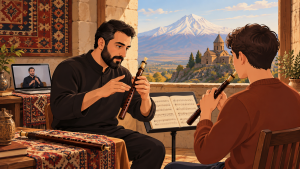
Start with fundamentals: producing a stable sound, learning basic fingering, controlling ordinary breathing, and becoming comfortable with the reed. Over time, those technical skills allow you to work toward the sustained expressive phrases heard in cinematic recordings.
Our guide Is Duduk Hard to Learn for Beginners? explains what new players should expect and why the instrument is accessible to beginners even though professional tone takes much longer to develop.
You can also use the Duduk Rocks learning resources to begin working on technique and traditional repertoire.
Does a Beginner Need the Same Duduk Used in Movie Scores?
No.
The emotional impact of a professional soundtrack does not come simply from purchasing an expensive instrument.
Professional musicians may select different duduks, reeds, or keys according to the musical range, recording situation, composer, and desired tonal color. Studio microphones, room acoustics, mixing, orchestration, and post-production also influence what audiences ultimately hear.
A beginner should concentrate first on obtaining a properly made, playable instrument with a suitable reed. Once your technique develops, you can explore additional keys and more specialized instruments according to your musical needs.
You can browse handmade duduks and reeds at Duduk Rocks and compare different options without assuming that the most expensive instrument will instantly produce a Hollywood soundtrack sound.
The player remains the most important part of that equation.
From Armenian Tradition to Global Cinema
The story of the duduk in movies is ultimately a story about what happens when a culturally specific instrument develops a global voice.
The duduk was not invented for Hollywood. Its history did not begin with Gladiator, and its purpose is not limited to creating atmospheric film music.
Long before international composers discovered it, the instrument occupied an important place in Armenian musical life. Its repertoire, construction, playing techniques, and cultural meanings developed through generations of musicians and craftspeople.
Film composers encountered that existing tradition and discovered a sound capable of functioning in entirely new contexts.
That distinction matters because it allows us to appreciate both worlds simultaneously. We can admire how Hans Zimmer incorporated Djivan Gasparyan into Gladiator while recognizing that Gasparyan brought an Armenian musical language and lifetime of experience into the studio. We can appreciate the duduk in Dune without pretending that the instrument originated in a fictional desert world.
The more internationally recognizable the sound becomes, the more valuable it is to remember the tradition behind it.
Frequently Asked Questions About Duduk in Movies
What famous movie uses the duduk?
Gladiator is one of the most famous examples. Armenian duduk master Djivan Gasparyan performed on Hans Zimmer and Lisa Gerrard’s score, helping introduce the sound of the instrument to a massive international audience.
Is there duduk in Gladiator?
Yes. Djivan Gasparyan performed duduk for the Gladiator score. Hans Zimmer has discussed specifically wanting to work with Gasparyan and the distinctive quality of his sound.
Who played duduk in Gladiator?
Armenian master Djivan Gasparyan played duduk on the Gladiator soundtrack.
Is the instrument in Gladiator Armenian?
Yes. The duduk is an Armenian double-reed wind instrument traditionally associated with apricot wood and Armenian musical culture.
What other movies feature Djivan Gasparyan?
Documented soundtrack credits connect Gasparyan with films including The Crow, Gladiator, Syriana, and Blood Diamond, among other international projects.
Is duduk used in Dune?
Yes. Duduk is among the wind colors used in Hans Zimmer’s musical world for Dune, with multi-instrumentalist Pedro Eustache associated with the instrument.
Is duduk used in Dune: Part Two?
Yes. The duduk continued to appear within the instrumental palette of Hans Zimmer’s score, with Pedro Eustache contributing to the wind performances.
Is there duduk in The Passion of the Christ?
Yes. Duduk is among the instruments used in John Debney’s score, with Chris Bleth credited on duduk and Pedro Eustache among the woodwind musicians.
Is duduk used in The Chronicles of Narnia?
Yes. Duduk appears in the score for The Chronicles of Narnia: The Lion, the Witch and the Wardrobe, notably in connection with “A Narnia Lullaby.”
Why is duduk used so often in movies?
Its breath-rich, expressive tone works particularly well for exposed melodic lines and can communicate intimacy, solitude, grief, mystery, or a sense of distance. Its distinctive timbre also contrasts effectively with a conventional symphony orchestra.
Is duduk a Middle Eastern instrument?
The duduk is specifically and strongly associated with Armenia and Armenian musical culture. Related double-reed instruments exist elsewhere in the region, but they should not simply be treated as identical instruments.
For a detailed comparison, read Middle Eastern Reed Instruments: How the Armenian Duduk Stands Apart.
Did Hollywood make the duduk famous?
Hollywood significantly increased international awareness of the instrument, particularly through major scores such as Gladiator. However, the duduk already had a long Armenian musical tradition and internationally respected performers before those films appeared.
Can I learn to play movie music on duduk?
Yes, but first develop fundamental tone production, fingering, breathing, intonation, and reed control. Professional soundtrack tone is the result of advanced technique as well as recording and production.
Discover the Instrument Behind the Soundtracks
Once you recognize the duduk, watching movies can become a different experience.
A sound that once seemed mysterious suddenly has an identity.
You may hear a solo emerging from an orchestra and recognize the characteristic vibration of the large double reed. You may notice the instrument appearing in a historical drama, fantasy world, thriller, or science-fiction score. And instead of simply thinking, “That sounds ancient,” you can identify the musical tradition behind the sound.
For listeners, that recognition opens the door to Armenian music.
For musicians, it can become the beginning of learning the instrument themselves.
If a movie soundtrack introduced you to the duduk, explore What Is a Duduk? to learn how the instrument works, then continue with Is Duduk Hard to Learn for Beginners? if you are considering playing it yourself.
You can also explore the Duduk Rocks Blog for guides covering Armenian duduk history, musicians, makers, reeds, craftsmanship, maintenance, and playing technique.
Conclusion
The history of duduk in movies demonstrates the extraordinary ability of one traditional instrument to travel across cultures, genres, and fictional worlds without losing the distinctive quality of its voice.
From Peter Gabriel’s work on The Last Temptation of Christ and Djivan Gasparyan’s appearance on The Crow to the enormous international exposure created by Gladiator, the duduk gradually became part of the vocabulary available to major film composers. Later scores including Syriana, The Passion of the Christ, Blood Diamond, The Chronicles of Narnia, Munich, Dune, and Dune: Part Two continued demonstrating how adaptable the instrument could be.
But perhaps the most important part of this story is not simply the number of famous films that contain duduk.
It is the musicians behind the sound.
When Hans Zimmer wanted the haunting voice of the duduk for Gladiator, he wanted Djivan Gasparyan. When Alexandre Desplat incorporated the instrument into Syriana, Gasparyan’s playing became part of the written score. Other specialists, including Pedro Eustache and Chris Bleth, helped carry the instrument into additional cinematic worlds.
These performers remind us that a duduk is not merely a sound effect.
It is an instrument that requires breath, reed control, intonation, phrasing, and musical understanding. Behind every sustained note is a musician shaping a natural cane reed with air and embouchure.
Cinema gave that sound an enormous international stage.
But its roots remain Armenian.
The next time you hear that warm, breathy, almost human voice emerge from a movie soundtrack, you may no longer wonder what instrument you are hearing.
You will recognize the duduk.
And perhaps that recognition will lead you beyond the soundtrack itself—to the musicians, makers, repertoire, and Armenian musical tradition that gave the instrument its voice.
Visit Duduk Rocks to discover more about the Armenian duduk, explore the Duduk Rocks Blog for educational guides, or browse handmade duduks and reeds if a movie soundtrack has inspired you to begin playing the instrument yourself.