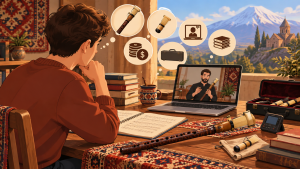
Where can I find a Duduk Instructor near me? Complete Guide to Finding Duduk Lessons
You have heard the Armenian duduk.
Perhaps you discovered its warm, expressive voice through Armenian music, a live performance, a movie soundtrack, or a recording online. Eventually, listening is no longer enough.
You want to learn how to create that sound yourself.
Then comes the question:
Where can I find a duduk instructor near me?
Finding a piano, guitar, or violin teacher in most cities is relatively straightforward. Finding an experienced duduk instructor can be more challenging.
The duduk remains a specialized traditional instrument, and qualified teachers are not available in every city. Fortunately, students today are no longer limited to instructors who live nearby.
You may be able to study with a local Armenian musician, join lessons through an Armenian cultural organization, attend a specialized music school, or learn directly from an experienced duduk player through live online lessons.
If you are completely new to the instrument, start with our guide What Is a Duduk? A Complete Guide to Armenia’s Most Expressive Wind Instrument. It explains the instrument’s construction, sound, history, reed system, and role in Armenian music before you begin learning to play.
You can also explore the wider collection of educational resources available on the Duduk Rocks Blog and Duduk-Rocks Youtube Videos.

Why Finding the Right Duduk Instructor Matters
The duduk looks quite simple.
Its wooden body has no complicated key mechanism. Compared with instruments such as the clarinet, saxophone, or oboe, there are relatively few visible components.
But producing the distinctive Armenian duduk sound requires several techniques working together.
A beginner needs to develop:
- Correct posture
- Proper hand position
- Accurate finger placement
- Breath control
- Embouchure
- Reed control
- Stable tone production
- Intonation
- Articulation
- Musical phrasing
The instrument itself also plays an important role. It is essential to keep in mind that the type of duduk and reed you choose is crucial.
The dimensions of the wooden body, the condition of the reed, and the relationship between the reed and instrument can all influence how easily a beginner produces a stable sound.
To understand the construction of the instrument in greater detail, read our guide to Armenian Duduk Craftsmanship.
Some techniques are especially difficult to evaluate alone.
A beginner may produce a note and assume everything is correct. An experienced teacher may immediately notice that the student’s embouchure is creating unnecessary tension, that the reed is not properly prepared, or that a finger is not completely sealing one of the holes.
Correcting these habits early can make the learning process considerably easier.
Where Can You Find a Duduk Instructor Near You?
There is no universal directory containing every duduk teacher in the world.
Instead, it helps to search through several channels.
1. Armenian Music Schools and Cultural Organizations
If you live in an area with a significant Armenian community, Armenian cultural organizations are one of the first places worth checking.
Depending on your location, you may find:
- Armenian music schools
- Cultural associations
- Community centers
- Armenian cultural programs
- Folk ensembles
- Traditional music groups
- Independent Armenian musicians
Even when an organization does not advertise formal duduk classes, musicians connected to the organization may know local performers who offer private instruction.
This can be especially valuable if you want to study traditional Armenian repertoire rather than simply learn basic notes.
The duduk is deeply connected with Armenian musical identity and cultural heritage. You can explore that history further in our guide to the Armenian Duduk.
2. Local Music Schools
Some general music schools include traditional instruments among their private lesson programs.
Duduk lessons remain much less common than piano, guitar, violin, or saxophone lessons, but they can sometimes be found in cities with active Armenian, Caucasian, or Middle Eastern musical communities.
When contacting a school, ask specifically whether the instructor has experience playing and teaching the Armenian duduk.
Being an experienced clarinet, oboe, or saxophone teacher does not automatically make someone a duduk specialist.
The large double reed, embouchure, fingering, tone production, and stylistic techniques of the duduk require specialized knowledge.
For a broader understanding of what distinguishes the instrument from other woodwinds, our Duduk Musical Instrument guide provides a detailed introduction.
3. Professional Duduk Players
Not every excellent duduk instructor works at a music school.
Many professional performers teach privately alongside their performing careers.
This can be an excellent option because students learn directly from musicians with practical experience using the instrument.
Send us your request, and we’ll connect you with a professional duduk teacher who’s the right fit for you.
When evaluating a teacher, look for evidence of:
- Duduk performance experience
- Teaching experience
- Good communication skills in your preferred language
- Armenian repertoire knowledge
- Recordings or performances
- Experience with beginners
- Knowledge of reeds and instrument setup
Remember that being an excellent performer and being an excellent teacher are not necessarily the same thing.
Teaching also requires the ability to identify technical problems, explain them clearly, structure exercises, and adapt to different students.
Online Duduk Lessons: Your Instructor Does Not Have to Be Nearby
For many people searching for a “duduk instructor near me,” the best solution may actually be online.
Live video lessons have dramatically expanded access to teachers of specialized traditional instruments.
A student in Canada, the United States, France, Germany, Australia, or another country can potentially study with an instructor located in Armenia or elsewhere in the world.
Online instruction is particularly valuable when:
- No duduk teacher lives in your city.
- You want to study with a specific musician.
- You live far from an Armenian cultural community.
- Transportation is difficult.
- You want specialized Armenian duduk instruction.
- Your schedule makes local lessons inconvenient.
For an instrument as specialized as the duduk, studying online with an experienced duduk teacher can often be more useful than studying locally with someone who does not actually specialize in the instrument.
Before beginning lessons, you will of course need your own instrument. You can browse the duduks available at Duduk Rocks if you are still looking for an instrument.
Can You Really Learn Duduk Online?
Yes.
Many fundamental aspects of duduk playing can be taught effectively through live video.
An instructor can visually evaluate:
- Posture
- Hand position
- Finger placement
- Embouchure
- Instrument position
- Breathing habits
They can also listen for:
- Tone quality
- Pitch
- Rhythm
- Articulation
- Phrasing
A teacher can demonstrate a technique, listen to your attempt, identify the problem, and provide immediate feedback.
There are naturally some limitations.
Computer and phone microphones do not reproduce the sound of the duduk exactly as it would be heard in person.
But for beginners and intermediate students, live online lessons can still provide extremely valuable technical guidance.
Private Duduk Lessons vs Recorded Courses
It is important to distinguish between live private lessons and recorded duduk courses.
Both can help, but they serve different purposes.
Live Private Lessons
A private teacher can react to what you are actually doing.
They can identify:
- Incorrect fingering
- Poor breathing habits
- Reed problems
- Intonation difficulties
- Embouchure tension
- Rhythm problems
- Incorrect articulation
The lesson then changes according to your individual progress.
This personalized feedback is one of the strongest reasons to work with an instructor.
Recorded Courses
Recorded courses allow you to watch exercises and demonstrations repeatedly.
They can be useful for:
- Reviewing fingerings
- Practicing exercises
- Learning melodies
- Revisiting techniques
- Supplementing private lessons
However, a video cannot hear your playing or tell you why something is going wrong.
For that reason, a combination of structured learning materials and occasional private instruction can be very effective.
Your Duduk Teacher Should Understand the Reed
One of the most important things a duduk teacher should understand is the reed.
The reed is not simply an accessory.
It is a fundamental part of the instrument’s acoustic system.
A beginner may struggle for several minutes to create a stable sound and assume their breathing or embouchure is incorrect.
Sometimes the actual problem is the reed.
A reed may be:
- Too closed
- Too open
- Too resistant
- Improperly prepared
- Poorly matched with the instrument
- Affected by environmental conditions
An experienced instructor should help you distinguish between a technique problem and an equipment problem.
This is one of the reasons purchasing a suitable instrument and reed before beginning lessons is so important.
You can explore available instruments in the Duduk Rocks Shop and find additional guides about instruments, reeds, makers, and playing techniques on the Duduk Rocks Blog.
Understanding Different Woodwind Backgrounds
Some students begin the duduk after already learning clarinet, saxophone, flute, oboe, or another wind instrument.
That previous experience can certainly help.
You may already understand concepts such as:
- Breath support
- Fingering coordination
- Musical phrasing
- Rhythm
- Pitch control
However, the duduk still requires adaptation.
Its large double reed behaves differently from the mouthpieces and reeds found on many Western woodwinds.
The instrument also belongs to its own musical tradition.
Even hybrid instruments demonstrate how different these systems can be. For example, the DuClar duduk-clarinet hybrid combines characteristics of two instrument families while retaining its own playing behavior.
Previous wind-instrument experience is therefore useful—but it does not replace actual duduk instruction.
You Need the Right Instrument Before Your First Lesson
Your teacher can help you learn, but your equipment also matters.
A poorly made or badly tuned duduk can make learning unnecessarily frustrating.
For beginners, this is particularly dangerous because you may not yet know whether an unstable note comes from your playing technique, the reed, or the instrument itself.
When choosing your first duduk, consider:
- The maker
- Key
- Tuning
- Reed quality
- Build quality
- Intended playing level
You can explore available handmade duduks and Armenian instruments at Duduk Rocks.
For additional guidance before purchasing, visit the Duduk Rocks website, where you can explore instruments alongside educational resources about the Armenian duduk.
Finding Duduk Lessons When There Is No Teacher Near You
If your initial search produces no local instructors, do not assume you cannot learn the instrument.
Instead of searching only:
“duduk instructor near me”
try searches such as:
- Online duduk instructor
- Duduk lessons online
- Armenian duduk teacher
- Private duduk lessons
- Learn Armenian duduk
- Armenian duduk lessons online
For a specialized musical instrument, being willing to learn remotely can dramatically expand your options.
Your ideal teacher may live in Armenia, France, the United States, Canada, or somewhere else entirely.
That changes the most important question.
Instead of asking only:
“Is there a duduk teacher near me?”
you can ask:
“Who is the right duduk teacher for me?”
And today, that person could be almost anywhere.
Continue Learning About the Duduk
Finding a good instructor is only one part of learning the Armenian duduk.
Understanding the instrument itself will also help you progress.
Continue exploring these resources:
- What Is a Duduk? A Complete Guide to Armenia’s Most Expressive Wind Instrument
- Armenian Duduk
- Duduk Musical Instrument
- Armenian Duduk Craftsmanship
- DuClar: Duduk-Clarinet Hybrid
You can also browse all our guides, stories, maker profiles, and educational articles on the Duduk Rocks Blog.
If you are ready to choose an instrument, explore the Duduk Rocks Shop.
Conclusion
Finding a duduk instructor may require more searching than finding a piano or guitar teacher, but geography no longer has to prevent you from learning.
Start by checking Armenian cultural organizations, traditional music schools, professional musicians, and local teachers.
If no qualified instructor is available nearby, broaden your search to online lessons.
For a specialized instrument like the Armenian duduk, the quality of the teacher is often more important than physical proximity.
Look for someone who understands not only fingering and breathing but also reeds, tone production, Armenian repertoire, phrasing, and the musical tradition surrounding the instrument.
Most importantly, begin with a suitable instrument and build strong fundamentals before moving toward advanced techniques.
At Duduk Rocks, you can continue learning about the Armenian duduk, explore its history and craftsmanship, read detailed educational guides, and discover available instruments as you begin your own musical journey.
Frequently Asked Questions
Where can I find a duduk instructor near me?
Start by checking Armenian cultural organizations, local music schools, professional duduk performers, and private music-teaching directories. If there is no qualified teacher nearby, live online lessons allow you to study with duduk specialists in other cities or countries.
Can I take Armenian duduk lessons online?
Yes. Live video lessons can be used to teach fingering, posture, embouchure, breathing, tone production, repertoire, and many other aspects of duduk playing.
Is an online duduk teacher as good as an in-person teacher?
It depends more on the quality of the instructor than on the format. In-person lessons make certain acoustic and physical observations easier, while online lessons provide access to a much larger number of specialized duduk teachers.
Do I need my own duduk before taking lessons?
You generally need access to a duduk for regular instruction and practice. If possible, ask your prospective instructor what type and key they recommend before purchasing.
You can also browse available duduks at Duduk Rocks.
Can I learn duduk if I have never played music before?
Yes. Previous musical experience can help, but it is not required. A good beginner instructor should introduce the instrument gradually, beginning with breathing, tone production, fingering, and simple exercises.
Is duduk difficult to learn?
Producing an initial sound may be achievable relatively early, but controlling tone, pitch, breathing, phrasing, and ornamentation requires regular practice.
Should my duduk instructor be Armenian?
Not necessarily. What matters most is genuine duduk training, teaching ability, technical knowledge, and—if you want to study traditional Armenian music—a strong understanding of Armenian performance style.
Can a clarinet or oboe teacher teach me duduk?
Possibly, but experience with another woodwind instrument alone is not enough. Look for someone who has specifically studied and played the duduk.
How often should I take duduk lessons?
Many students benefit from regular weekly instruction, but the ideal schedule depends on your goals and ability to practice between lessons.
Can I teach myself duduk?
Self-study resources can help, particularly with basic information and fingering. However, occasional instruction can be valuable for correcting problems with embouchure, reeds, breathing, intonation, and technique.
What duduk should a beginner buy?
The best choice depends on your teacher, musical goals, key, reed, and instrument quality. If possible, ask an instructor for guidance before purchasing.
You can explore handmade duduks and other instruments available through Duduk Rocks.