Es befinden sich keine Produkte im Warenkorb.

Share

Duduk Mouthpiece Guide: How the Reed Shapes the Soulful Sound of the Duduk

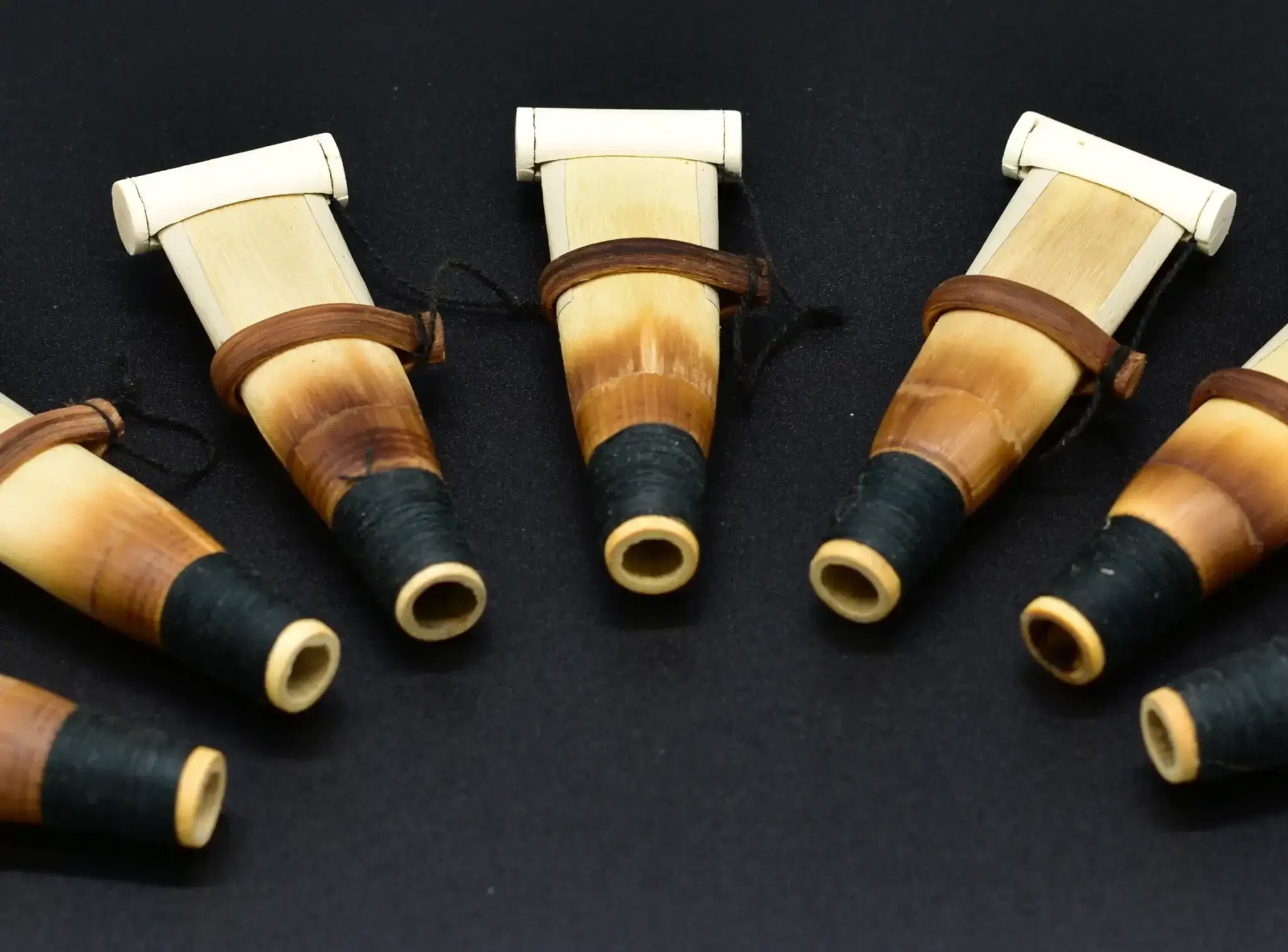
The Armenian duduk is known around the world for its warm, emotional, and deeply human sound. While many people focus on the wooden body of the instrument, experienced musicians understand that one of the most important elements of the duduk is its mouthpiece — more precisely, its reed.

The duduk mouthpiece plays a central role in shaping the instrument’s tone, response, expression, and emotional depth. Without a properly crafted reed, even the finest duduk cannot produce the smooth and haunting sound that has made Armenian duduk music famous across generations.
👉 Discover the Armenian Duduk: https://duduk-rocks.com/
👉 Explore more articles: https://duduk-rocks.com/blog/

The Evolution of the Duduk: From Reed to Wood

In its earliest beginnings, the historical duduk was constructed entirely from the reed plant. The body and the mouthpiece were one. Over time, the instrument evolved: craftsmen decided to build the duduk body from durable wood (predominantly apricot wood) while retaining the reed solely for the mouthpiece. This combination allowed for better structural integrity while preserving the unique acoustic properties of the plant.

Traditional Materials: Quality Starts in the Field

For centuries, Armenian duduk makers have used natural reed cane known as Arundo donax to create mouthpieces (ghamish). However, not all plants are created equal.

The Secret of the Masters: Only a very small fraction of reed plants are suitable as raw material for high-quality duduk mouthpieces. Truly excellent material is rare. Most master makers travel to the fields themselves to hand-pick and harvest the cane. They know that sound quality begins on the field; the soil, the climate, and the timing of the harvest are the foundation of a professional reed.

The Anatomy of the Mouthpiece: More than just a Reed

While the vibrating cane is the heart of the sound, supposedly “minor” parts of the mouthpiece have critical functions. For a duduk to perform correctly, all components must be perfectly coordinated.

The Cap: Protection and Preservation

The cap is far more than a simple cover. Its primary jobs are:

  • Protection: It shields the delicate tip from physical damage.
  • Shape Retention: During rest periods, the cap ensures the tip of the mouthpiece does not warp or lose its symmetry.

Pro Tip: The cap must enclose the tip properly—it should be neither too loose nor too tight. It should be firmly seated so that the tip is completely sealed. You can visually check this, or perform a seal test: blow into the bottom end of the mouthpiece while the cap is on; no air should escape from the front.

The Regulator: The Soul of Adjustment

The regulator is a wooden clamp made from the bark of the grapevine. Though it looks simple, it is vital for the instrument’s playability:

  • Aperture Control: It regulates how far the reed stays open.
  • Pitch Adjustment: It allows the player to fine-tune the intonation.

In an ideal setup, there should be no air gap between the regulator and the mouthpiece. The regulator should “embrace” the reed fully and snugly to ensure maximum control over the vibration.

Why the Duduk Mouthpiece is so Important

The reed does much more than simply produce sound. It directly affects:

  • Tone quality & Air resistance
  • Dynamic control & Intonation
  • Emotional expression & Flexibility

Traditional duduk performance relies on emotional nuance. Because of this, the mouthpiece must respond with precision to even the smallest changes in breath pressure and lip control.

How a Duduk Mouthpiece is Made

Creating a traditional duduk mouthpiece involves several detailed steps. First, selected pieces of reed cane are softened in water. Once flexible, they are trimmed and shaped carefully to achieve the correct thickness. The process includes:

  1. Sanding & Fine cutting
  2. Lip shaping
  3. Thread wrapping
  4. Regulator installation (using grapevine bark)
  5. Precision tuning

Choosing the Right Duduk Mouthpiece

Choosing the right mouthpiece depends on several factors:

  • Playing Experience: Beginners often prefer softer reeds, while advanced players choose stronger reeds for greater control.
  • Instrument Key: Reeds must be matched to the specific size of the duduk.
  • Climate: Natural reeds react to humidity. Professional players often own multiple reeds and rotate between 2–3 mouthpieces to allow the material time to rest and dry.

Conclusion

The duduk mouthpiece is far more than a simple accessory. It is the living heart of the instrument. From the hand-harvested cane in the fields to the perfectly fitted grapevine regulator and protective cap, every detail contributes to the “soul” of the sound. Understanding these components is the first step toward mastering the hauntingly beautiful Armenian musical tradition.

FAQ About Duduk Mouthpieces

What is a duduk mouthpiece made from?

It is made from Arundo donax reed cane. The regulator is traditionally made from grapevine bark.

Why is the cap so important?

The cap protects the tip from damage and prevents the reed from deforming while it is not being played. It must fit perfectly to seal the tip.

What was the historical duduk made of?

Originally, the entire duduk (body and mouthpiece) was made from the reed plant before craftsmen switched to apricot wood for the body.

How do I check if my cap fits correctly?

Visually inspect if the tip is fully closed. If in doubt, blow into the back of the reed; if no air escapes from the front, the fit is correct.

How long does a mouthpiece last?

With proper care, a mouthpiece lasts from several months to two years. Using a rotation of 2-3 reeds helps extend their lifespan.


We use cookies to optimize our website and provide you with the best possible user experience. By continuing to use our site, you consent to the use of cookies. Learn more. View more
Cookies settings
Accept
Privacy & Cookie policy
Privacy & Cookies policy
Cookie name Active
Privacy Policy 1. Controller The controller responsible for data processing on this website within the meaning of the General Data Protection Regulation (GDPR) is: Duduk-Rocks GbR Artur Demurchyan Andersen Str. 10a 59557 Lippstadt Germany Phone: +49 159-04099627 Email: info@duduk-rocks.com 2. Collection and Storage of Personal Data and the Nature and Purpose of their Use a) When visiting the website When you visit our website www.duduk-rocks.com, www.dudukrocks.com or www.duduk.rocks, the browser used on your device automatically sends information to the server of our website. This information is temporarily stored in a so-called log file. The following information is collected without your intervention and stored until automated deletion:
    • IP address of the requesting computer
    • Date and time of access
    • Name and URL of the retrieved file
    • Website from which access is made (referrer URL)
    • Used browser and, if applicable, the operating system of your computer as well as the name of your access provider
The mentioned data is processed by us for the following purposes:
    • Ensuring a smooth connection setup of the website
    • Ensuring comfortable use of our website
    • Evaluation of system security and stability as well as for further administrative purposes
The legal basis for data processing is Art. 6 para. 1 sentence 1 lit. f GDPR. Our legitimate interest follows from the purposes listed above for data collection. In no case do we use the collected data for the purpose of drawing conclusions about your person. b) When using our contact form If you have any questions, we offer you the opportunity to contact us via a form provided on the website. It is necessary to provide a valid email address so that we know who the request is from and to be able to respond to it. Further information can be provided voluntarily. Data processing for the purpose of contacting us is based on your voluntarily given consent pursuant to Art. 6 para. 1 sentence 1 lit. a GDPR. The personal data collected by us for the use of the contact form will be automatically deleted after the request you have made is completed. 3. Data Disclosure Your personal data will not be transferred to third parties for purposes other than those listed below. We will only share your personal data with third parties if:
    • You have given your express consent pursuant to Art. 6 para. 1 sentence 1 lit. a GDPR,
    • the disclosure is necessary for the establishment, exercise or defense of legal claims pursuant to Art. 6 para. 1 sentence 1 lit. f GDPR and there is no reason to assume that you have an overriding legitimate interest in not disclosing your data,
    • in the event that there is a legal obligation for the disclosure pursuant to Art. 6 para. 1 sentence 1 lit. c GDPR, and
    • it is legally permissible and required for the performance of a contract with you pursuant to Art. 6 para. 1 sentence 1 lit. b GDPR.
4. Rights of Data Subjects You have the right:
    • pursuant to Art. 15 GDPR to request information about your personal data processed by us. In particular, you can request information about the processing purposes, the category of personal data, the categories of recipients to whom your data has been or will be disclosed, the planned storage period, the existence of a right to rectification, erasure, restriction of processing or objection, the existence of a right to lodge a complaint, the source of your data, if it was not collected by us, as well as the existence of automated decision-making including profiling and, if applicable, meaningful information about its details;
    • pursuant to Art. 16 GDPR to request the rectification of incorrect or the completion of your personal data stored by us without undue delay;
    • pursuant to Art. 17 GDPR to request the erasure of your personal data stored by us, unless the processing is necessary for the exercise of the right to freedom of expression and information, for the fulfillment of a legal obligation, for reasons of public interest or for the establishment, exercise or defense of legal claims;
    • pursuant to Art. 18 GDPR to request the restriction of the processing of your personal data, insofar as the accuracy of the data is disputed by you, the processing is unlawful, but you oppose its erasure and we no longer need the data, but you need it for the establishment, exercise or defense of legal claims or you have objected to the processing pursuant to Art. 21 GDPR;
    • pursuant to Art. 20 GDPR to receive your personal data, which you have provided to us, in a structured, commonly used and machine-readable format or to request the transfer to another controller;
    • pursuant to Art. 7 para. 3 GDPR to withdraw your consent at any time. As a result, we may no longer continue the data processing based on this consent for the future and
    • pursuant to Art. 77 GDPR to lodge a complaint with a supervisory authority. As a rule, you can contact the supervisory authority of your usual place of residence or workplace or our company headquarters.
5. Right to Object If your personal data is processed based on legitimate interests pursuant to Art. 6 para. 1 sentence 1 lit. f GDPR, you have the right to object to the processing of your personal data pursuant to Art. 21 GDPR, insofar as there are reasons for this arising from your particular situation or the objection is directed against direct marketing. In the latter case, you have a general right to object, which we will implement without specifying a particular situation. If you wish to exercise your right to withdraw or object, just send an email to info@duduk-rocks.com. 6. Data Security We use the widespread SSL (Secure Socket Layer) procedure in connection with the highest encryption level supported by your browser when you visit the website. Typically, this is 256-bit encryption. If your browser does not support 256-bit encryption, we use 128-bit v3 technology instead. You can tell whether a single page of our website is transmitted in encrypted form by the closed display of the key or lock symbol in the lower status bar of your browser. We also use appropriate technical and organizational security measures to protect your data against accidental or intentional manipulation, partial or complete loss, destruction or unauthorized access by third parties. Our security measures are continuously improved in line with technological developments. 7. Validity and Changes to this Privacy Policy This privacy policy is currently valid and was last updated in July 2024. Due to the further development of our website and offers above or due to changed legal or official requirements, it may be necessary to change this privacy policy. The current privacy policy can be viewed and printed by you at any time on the website at www.duduk-rocks.com. 8. Cookies We use cookies on our website. Cookies are small files that your browser automatically creates and that are stored on your device (laptop, tablet, smartphone, etc.) when you visit our site. Cookies do not harm your device and do not contain viruses, trojans, or other malicious software. Information is stored in the cookie, which results in each case in connection with the specific device used. However, this does not mean that we are immediately aware of your identity. The use of cookies serves to make the use of our offer more pleasant for you. For example, we use session cookies to recognize that you have already visited individual pages of our website. These are automatically deleted after leaving our site. In addition, we also use temporary cookies to optimize user-friendliness, which are stored on your device for a certain fixed period. If you visit our site again to use our services, it is automatically recognized that you have already been with us and what entries and settings you have made, so you do not have to enter them again. We also use cookies to statistically record the use of our website and to evaluate it for you for the purpose of optimizing our offer (see Section 5). These cookies enable us to recognize automatically when you visit our site again that you have already been with us. These cookies are automatically deleted after a defined period. The data processed by cookies are necessary for the purposes mentioned to protect our legitimate interests as well as those of third parties according to Art. 6 para. 1 sentence 1 lit. f GDPR. Most browsers accept cookies automatically. However, you can configure your browser so that no cookies are stored on your computer or a message always appears before a new cookie is created. However, completely disabling cookies may mean that you cannot use all the functions of our website. For more information on the cookies we use and to manage your cookie preferences, please visit our [Cookie Policy] (Link to Cookie Policy).
Save settings
Cookies settings