Middle Eastern Reed Instruments: How the Armenian Duduk Stands Apart
Across the Middle East, the South Caucasus, Anatolia, and Central Asia, reed and wind instruments have shaped musical traditions for centuries. Their sounds appear in folk celebrations, spiritual ceremonies, village dances, classical repertoires, and modern concert stages. Some are soft and meditative. Others are loud, bright, and designed for outdoor performance. Some use a single reed, some use a double reed, and others, such as the ney, are made from reed cane but do not use a vibrating reed at all.
Among these instruments, the Armenian duduk holds a unique place.
At first glance, the duduk may seem closely related to instruments such as the Turkish mey or Azerbaijani balaban. These instruments are indeed part of a broader family of cylindrical double-reed aerophones. They share general similarities in shape, playing method, and regional history. However, treating them as the same instrument would be inaccurate.
The Armenian duduk is defined not only by its physical construction, but also by its tone, repertoire, performance style, playing technique, craftsmanship, and cultural meaning. Traditionally made from apricot wood and played with a large double reed, the duduk produces a warm, soft, deeply expressive sound that is often compared to the human voice.
Its importance has been formally recognized by UNESCO, which inscribed “Duduk and its music” on the Representative List of the Intangible Cultural Heritage of Humanity in 2008. This recognition highlights not just the instrument itself, but the musical tradition, craftsmanship, and transmission of knowledge surrounding it.
This article explores the wider world of Middle Eastern and regional reed instruments, including the duduk, mey, balaban, zurna, and ney. More importantly, it explains how the Armenian duduk stands apart from its relatives and why it has become one of the most emotionally powerful wind instruments in the world.
What is a Reed Instrument?
A reed instrument is a wind instrument that produces sound through the vibration of a reed or reeds. When air passes through the reed, it vibrates and creates sound waves that are shaped by the body of the instrument.
Reed instruments can be divided into several major categories.
Single-Reed Instruments
Single-reed instruments use one vibrating reed attached to a mouthpiece. The clarinet and saxophone are well-known examples in Western music.
In these instruments, the reed vibrates against the mouthpiece when the player blows air through it.
Double-Reed Instruments
Double-reed instruments use two pieces of reed that vibrate against each other. The oboe and bassoon are familiar Western examples.
The Armenian duduk, Turkish mey, Azerbaijani balaban, and zurna also belong to the double-reed family, though their construction and musical roles differ greatly from Western orchestral instruments.
Reed Flutes and Cane Flutes
Some instruments are made from reed cane but do not use a vibrating reed. The ney is an important example.
The ney is an end-blown flute. It is usually made from reed cane, but its sound is produced by blowing air across an edge rather than vibrating a reed. This distinction is important because many people mistakenly place the ney in the same category as the duduk. In reality, the ney belongs to the flute family, while the duduk belongs to the double-reed family.
The Armenian Duduk: A Soft Double-Reed Voice
The Armenian duduk is a traditional double-reed woodwind instrument. It is usually handcrafted from seasoned apricot wood and played with a large reed.
Its sound is warm, soft, slightly nasal, and deeply expressive. Unlike many reed instruments that are designed to project loudly, the duduk is known for intimacy and emotional nuance.
The instrument typically has:
- A cylindrical wooden body
- Eight finger holes on the front
- One thumb hole on the back
- A large double reed
- A warm and mellow tone
- A strong connection to Armenian musical identity
One of the most important features of traditional duduk performance is the use of two musicians. One musician plays the melody, while the second plays a sustained drone called the dam. This creates a rich musical foundation that supports the expressive melodic line.
This pairing gives Armenian duduk music its unmistakable atmosphere. The melody floats above the drone, allowing the performer to use subtle ornamentation, breath control, pitch shading, and expressive phrasing.
The duduk is used in many Armenian cultural contexts, including weddings, folk celebrations, commemorative ceremonies, and concert performances. Over time, it has also become widely recognized in international film music and world music.
For a full introduction to the instrument, read:
What is a Duduk? A Complete Guide to Armenia’s Most Expressive Wind Instrument
Why the Duduk is Often Compared to Other Regional Instruments
The Armenian duduk is frequently compared to the mey and balaban because these instruments share several structural features.
They are all:
- Double-reed wind instruments
- Traditionally made from wood
- Played with a large reed
- Associated with regional folk traditions
- Built with finger holes on the front and a thumb hole on the back
- Capable of expressive melodic playing
Because of these similarities, non-specialists sometimes describe them as variations of the same instrument. However, this simplification ignores important differences.
Each instrument developed within a specific cultural, linguistic, musical, and regional context. Each has its own repertoire, playing technique, tuning approach, makers, terminology, and performance traditions.
A careful comparison shows that the Armenian duduk is not a regional adaptation of another instrument. It is one of the oldest documented double-reed instruments of the region, with roots in Armenia reaching back well over a thousand years, and its distinctive sound and construction have influenced related instruments across neighbouring musical traditions.
This distinction is worth stating clearly, because the origins of the duduk are occasionally blurred or claimed by other musical traditions in the region. Similar double-reed instruments do exist under different names, and while these instruments have their own value within their respective cultures, they should not be confused with the Armenian duduk itself. The clearest point of reference here is international recognition: UNESCO proclaimed the duduk and its music a Masterpiece of the Oral and Intangible Heritage of Humanity in 2005, and inscribed it on the Representative List of the Intangible Cultural Heritage of Humanity in 2008, explicitly as an Armenian cultural tradition. For musicians and collectors, knowing this context is part of understanding what an authentic Armenian duduk actually represents, an instrument inseparable from the culture, language, and history that shaped it.
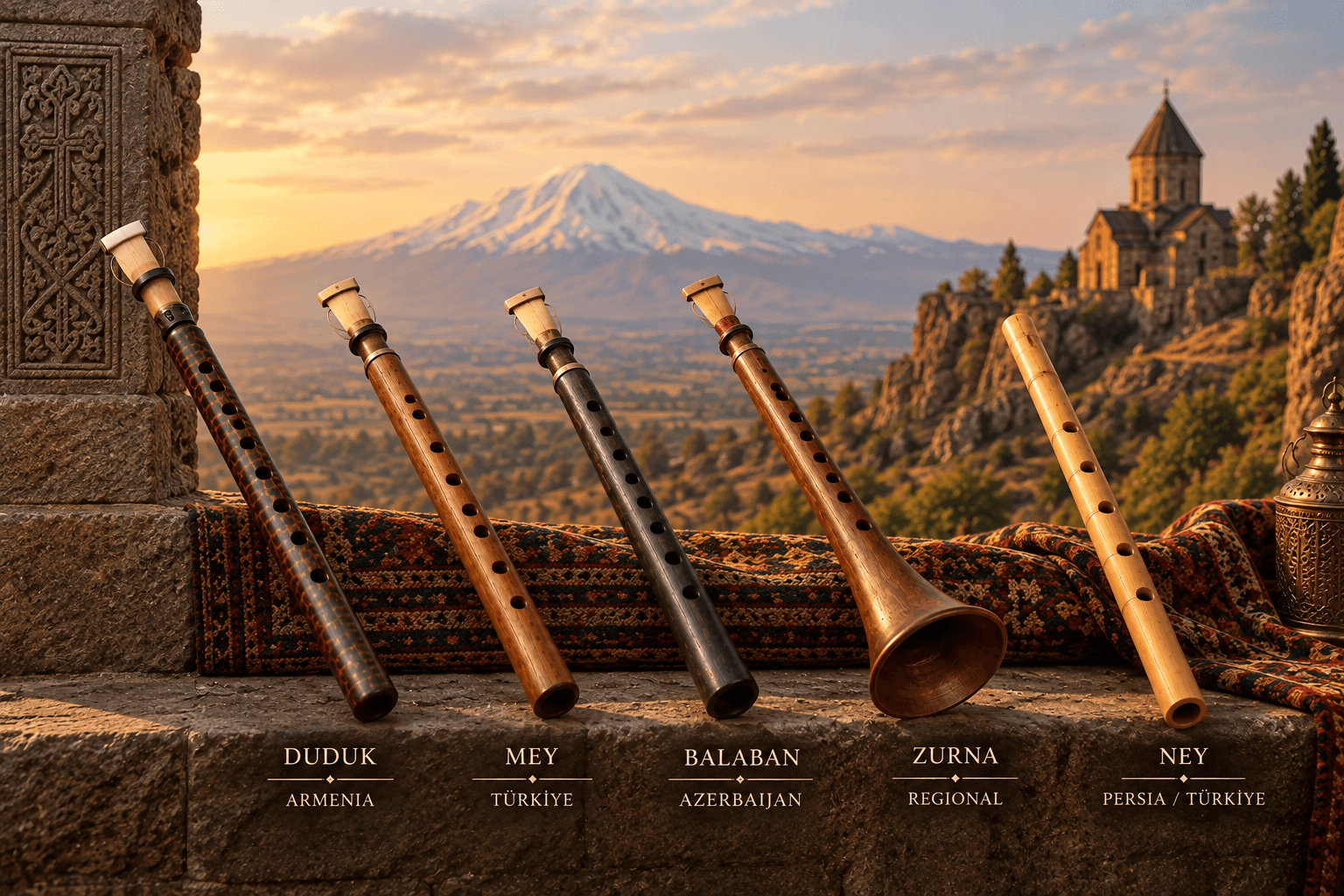
Duduk vs Mey: Similar Family, Different Musical Identity
The mey is a traditional double-reed instrument used in Turkish folk music. Like the duduk, it has a wooden body and a large reed. It is also generally cylindrical and has finger holes on the front and one on the back.
Because of these similarities, the mey and duduk are among the most frequently compared instruments.
However, several differences matter.
Cultural Tradition
The mey is strongly associated with Turkish folk traditions, especially regional music from Anatolia. The duduk, by contrast, is central to Armenian musical heritage.
This difference is not simply about geography. It affects repertoire, ornamentation, phrasing, musical scales, teaching methods, and performance contexts.
A Turkish mey player and an Armenian duduk player may use instruments that look similar, but their musical language is not the same.
Sound Character
The duduk is especially known for its soft, warm, and breath-like tone. Its sound is often described as intimate and vocal.
The mey can also produce an expressive tone, but it is commonly associated with a stronger, more direct folk sound depending on the instrument, reed, and regional style.
The exact tonal difference can vary from maker to maker and performer to performer, but the Armenian duduk tradition generally emphasizes softness, lyricism, and sustained emotional phrasing.
Reed and Response
Both instruments use large double reeds, but reed design, adjustment, and playing response may differ.
For duduk players, reed control is one of the most important parts of performance. Small changes in humidity, reed opening, and pressure can affect tuning and tone. A skilled player learns to adjust the reed constantly to maintain the desired sound.
Repertoire
The duduk is closely associated with Armenian songs, dances, laments, and traditional melodies. The mey is linked to Turkish folk repertoire.
This distinction matters because an instrument is not defined only by its shape. It is also defined by the music it carries.
Duduk vs Balaban: Close Relatives, Separate Traditions
The balaban is a double-reed woodwind instrument associated with Azerbaijani musical traditions. Like the duduk and mey, it belongs to the family of cylindrical double-reed aerophones.
The balaban is another instrument often compared with the Armenian duduk.
Similarities
The duduk and balaban can appear similar because both commonly feature:
- A wooden body
- A large double reed
- Finger holes on the front
- A thumb hole on the back
- A mellow double-reed tone
- Use in regional folk and art music traditions
These similarities are real and should not be ignored. The instruments belong to a wider regional family.
Differences
However, the Armenian duduk and Azerbaijani balaban differ in cultural identity, repertoire, playing style, and performance tradition.
The duduk is inseparable from Armenian musical heritage and is internationally recognized through UNESCO’s listing of “Duduk and its music.” The balaban is rooted in Azerbaijani musical culture and appears in its own traditional and classical contexts.
Even when two instruments are physically similar, the musical result can be different because of:
- Reed preparation
- Tuning preferences
- Ornamentation
- Local scales and modes
- Regional repertoire
- Performance aesthetics
- Teaching traditions
For this reason, it is more accurate to describe the duduk and balaban as closely related instruments rather than the same instrument.
Duduk vs Zurna: Intimacy vs Projection
The zurna is one of the most powerful reed instruments in the broader Middle Eastern, Balkan, Caucasian, and Central Asian musical world.
Unlike the duduk, the zurna is designed for volume and outdoor projection.
It is commonly associated with:
- Outdoor celebrations
- Weddings
- Festivals
- Processions
- Dance music
- Public ceremonies
The zurna usually has a conical bore, which contributes to its loud, bright, penetrating sound. It is often paired with drums, especially in outdoor contexts.
The Armenian duduk, by contrast, has a cylindrical bore and a much softer sound. It is not designed to cut through large outdoor crowds in the same way. Instead, it is valued for its emotional subtlety.
This contrast shows how different reed instruments serve different musical purposes.
The zurna is energetic, public, and powerful.
The duduk is intimate, lyrical, and reflective.
Both are double-reed instruments, but their emotional worlds are completely different.
Duduk vs Ney: A Common Misunderstanding
The ney is often mentioned in the same conversation as the duduk because both instruments are associated with Middle Eastern and regional musical traditions. However, they are not the same type of instrument.
The ney is an end-blown flute. It is usually made from reed cane and produces sound when the player blows across the edge of the tube.
The duduk is a double-reed woodwind. Its sound comes from the vibration of two reed blades.
This means the ney and duduk differ in:
- Sound production
- Playing technique
- Mouth position
- Tone formation
- Breath control
- Musical tradition
- Instrument classification
The ney is especially important in Persian, Turkish, Arabic, and Sufi musical traditions. Its tone is airy, spiritual, and flute-like.
The duduk is warmer, denser, and more reed-based in tone. It is closely tied to Armenian folk and cultural traditions.
So while both instruments can sound deeply emotional, they achieve that emotion through very different acoustic and musical means.
A Note on Mislabelled Instruments
Because the Armenian duduk has become internationally known and demand for it continues to grow, a number of online sellers now market mey and balaban instruments under the name “duduk.” These are legitimate instruments within their own traditions, but they are not Armenian duduks: they differ in bore dimensions, reed construction, tuning, and above all in the tonal character and playing feel that define the duduk.
To an untrained eye, the difference is not obvious at first glance. In photographs, the instruments can look almost identical, and the distinction only becomes clear once the instrument is in your hands and under your breath — often after the purchase has already been made.
For this reason, we recommend buying your Armenian duduk from a specialised seller who works directly with Armenian master makers, and seeking advice before you order. A short conversation beforehand is usually enough to make sure that the instrument you receive is genuinely what you are looking for.
Why the Armenian Duduk Stands Apart
After comparing the duduk with the mey, balaban, zurna, and ney, several defining features become clear.
The Armenian duduk stands apart because of:
- Its traditional apricot wood construction
- Its large double reed
- Its soft, warm, vocal-like sound
- Its use of the dam drone in traditional performance
- Its deep connection to Armenian cultural identity
- Its recognition by UNESCO
- Its strong role in both traditional and contemporary music
- Its ability to express subtle emotional states
The duduk is not the loudest reed instrument. It is not the brightest. It is not the easiest to master.
Its power lies in something more delicate: the ability to sound human.
That is why listeners often describe the duduk as emotional, ancient, soulful, or unforgettable.
Construction: Why Small Differences Matter
At first glance, the Armenian duduk, Turkish mey, and Azerbaijani balaban appear remarkably similar. They all feature a short cylindrical body, finger holes, and a large double reed. However, experienced musicians and instrument makers know that even small differences in construction can significantly influence the instrument’s response, tuning, and tonal character.
Wood Selection
One of the defining characteristics of the Armenian duduk is its traditional construction from Aprikosenholz.
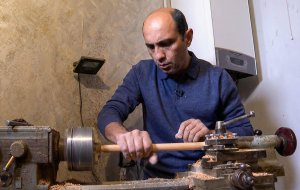
Apricot wood has been used by Armenian craftsmen for generations because of its density, stability, and acoustic qualities. After harvesting, the wood is carefully seasoned—often for several years—before it is carved into an instrument.
This long drying process helps stabilize the wood and contributes to the mellow, resonant sound for which the duduk is known.
Although meys and balabans are also crafted from hardwoods, the choice of wood varies among regions and individual makers. Depending on local traditions, woods such as plum, walnut, or other dense hardwoods may be used. The resulting instruments often produce tonal characteristics that differ from those of the traditional Armenian apricot-wood duduk.
The Importance of the Reed
If the wooden body shapes the sound, the reed gives the instrument its voice.
The Armenian duduk uses an unusually large double reed compared with many Western double-reed instruments.
This oversized reed allows the player to produce:
- exceptionally smooth attacks
- subtle dynamic changes
- expressive vibrato
- delicate pitch bending
- vocal-like phrasing
Professional duduk players devote considerable attention to their reeds.
They frequently adjust the reed according to:
- humidity
- temperature
- altitude
- playing conditions
- personal preference
Even a slight adjustment may noticeably change the instrument’s response.
For this reason, experienced players often carry several reeds to performances.
If you would like to learn more, explore:
- Duduk Reed Explained
- Duduk Mouthpiece Guide
Bore Design
Another major difference lies inside the instrument.
The Armenian duduk traditionally features a cylindrical bore, meaning that the interior maintains a relatively consistent diameter throughout most of its length.
This design contributes to:
- warm tone
- smooth response
- soft projection
- stable low register
By comparison, the zurna has a conical bore, allowing it to produce much greater volume and projection.
The bore design is one of the primary reasons why these two instruments sound so different despite both using double reeds.
Musical Roles Across the Region
Although these instruments belong to related families, each fulfills a different musical purpose.
Armenian Duduk
The duduk specializes in:
- lyrical melodies
- emotional expression
- contemplative repertoire
- intimate ensemble performance
- traditional Armenian songs
Its relatively quiet volume makes it particularly effective in smaller performance settings where subtle phrasing can be appreciated.
Turkish Mey
The mey is commonly heard in:
- Anatolian folk music
- regional vocal accompaniment
- village traditions
- folk ensembles
Its repertoire reflects the diversity of Turkish regional music.
Azerbaijani Balaban
The balaban occupies an important place in Azerbaijani music.
It appears in:
- mugham-related contexts
- folk ensembles
- ceremonial music
- solo performances
Its playing style reflects Azerbaijani musical aesthetics rather than Armenian traditions.
Persian Ney
The ney occupies a completely different musical world.
It is especially associated with:
- Persian classical music
- Turkish classical music
- Arabic traditions
- Sufi devotional music
Its expressive qualities arise from sophisticated breath control rather than a vibrating reed.
Zurna
The zurna is designed for:
- festivals
- outdoor ceremonies
- processions
- weddings
- energetic dance music
Its powerful sound allows it to project across large open spaces where softer instruments such as the duduk would be difficult to hear.
Ornamentation and Playing Technique
Perhaps the greatest distinction between these instruments lies not in their appearance but in the way musicians perform.
Traditional Armenian duduk playing emphasizes:
- controlled breath
- smooth phrasing
- restrained ornamentation
- emotional nuance
- long melodic lines
Many performances unfold gradually, allowing the melody to develop with remarkable subtlety.
By contrast, zurna performance often favors:
- energetic articulation
- rapid ornaments
- rhythmic vitality
- strong projection
Likewise, ney performers develop highly specialized embouchure techniques that differ completely from those used on double-reed instruments.
These performance traditions have evolved independently over centuries and contribute significantly to each instrument’s musical identity.
Why UNESCO Recognized the Armenian Duduk
One of the strongest distinctions of the Armenian duduk is its formal international recognition.
In 2008, UNESCO inscribed “Duduk and its music” on the Representative List of the Intangible Cultural Heritage of Humanity.
Importantly, UNESCO did not recognize only the physical instrument.
The inscription highlights:
- craftsmanship
- traditional knowledge
- musical repertoire
- performance practice
- transmission between generations
- cultural identity
This recognition emphasizes that the value of the duduk lies as much in its living tradition as in the instrument itself.
Choosing the Right Instrument
For musicians exploring traditional wind instruments, choosing between these instruments depends largely on musical goals.
The Armenian duduk is particularly suitable for players seeking:
- expressive solo performance
- lyrical melodies
- warm tone
- Armenian repertoire
- chamber music
- contemplative music
The zurna may appeal to performers interested in:
- outdoor performance
- dance music
- ceremonial traditions
The ney attracts musicians fascinated by Persian, Turkish, Arabic, or Sufi musical traditions.
Meanwhile, the mey and balaban offer opportunities to explore the rich folk traditions of Türkiye and Azerbaijan respectively.
Rather than asking which instrument is “better,” it is more meaningful to appreciate how each serves a different artistic purpose.
Frequently Asked Questions
Is the Armenian duduk older than the mey or the balaban?
The precise historical development of these related instruments cannot be established with complete certainty. Scholars generally recognize that they belong to a broader family of regional double-reed instruments that evolved over long periods. It is more accurate to compare their documented traditions than to make definitive claims about which appeared first.
Are the duduk, mey, and balaban interchangeable?
No.
Although they share structural similarities, each instrument has developed within its own cultural tradition, repertoire, craftsmanship, and performance practice.
Professional musicians generally study each instrument within its own musical context.
Why does the duduk sound softer?
Its cylindrical bore, large reed, and traditional playing style emphasize warmth and subtle expression rather than volume.
Is the ney easier than the duduk?
Not necessarily.
The ney requires extremely precise breath control and embouchure, while the duduk demands careful reed control and expressive phrasing.
Each presents different technical challenges.
Which instrument is best for beginners?
There is no universal answer.
The best choice depends on the music you wish to play.
Students interested in Armenian music generally begin with the duduk, while those interested in Persian classical traditions often choose the ney.
Continue Exploring
If you enjoyed this guide, continue exploring Armenia’s musical heritage through our related articles:
- Armenian Duduk: History, Sound, Craftsmanship, and Cultural Significance
- From Tree to Instrument: The Journey of a Handmade Duduk
- Karen Mukayelyan: The Armenian Duduk Maker Behind World-Class Handmade Instruments
Fazit
The Middle East and the South Caucasus are home to an extraordinary diversity of wind instruments, each reflecting centuries of musical creativity and cultural identity.
The Armenian duduk shares historical and organological connections with instruments such as the mey and balaban, yet it has developed its own unmistakable voice through Armenian craftsmanship, repertoire, and performance tradition.
Its apricot wood body, large double reed, intimate sound, and unique performance practices distinguish it from other regional instruments.
More importantly, the duduk represents a living cultural tradition that continues to be passed from master craftsmen and musicians to new generations around the world.
Whether heard in a village celebration, a concert hall, or a film soundtrack, the Armenian duduk remains one of the most expressive wind instruments ever created—an instrument whose voice continues to connect listeners with Armenia’s rich musical heritage.