How Much Does It Cost to Learn Duduk? Lessons, Instrument & Beginner Budget
Deciding to learn the Armenian duduk often begins with its sound.
You hear the warm, expressive voice of the instrument and start wondering what it would feel like to play it yourself.
Then a practical question appears:
How much does it cost to learn duduk?
The answer depends on much more than the price of a single lesson.
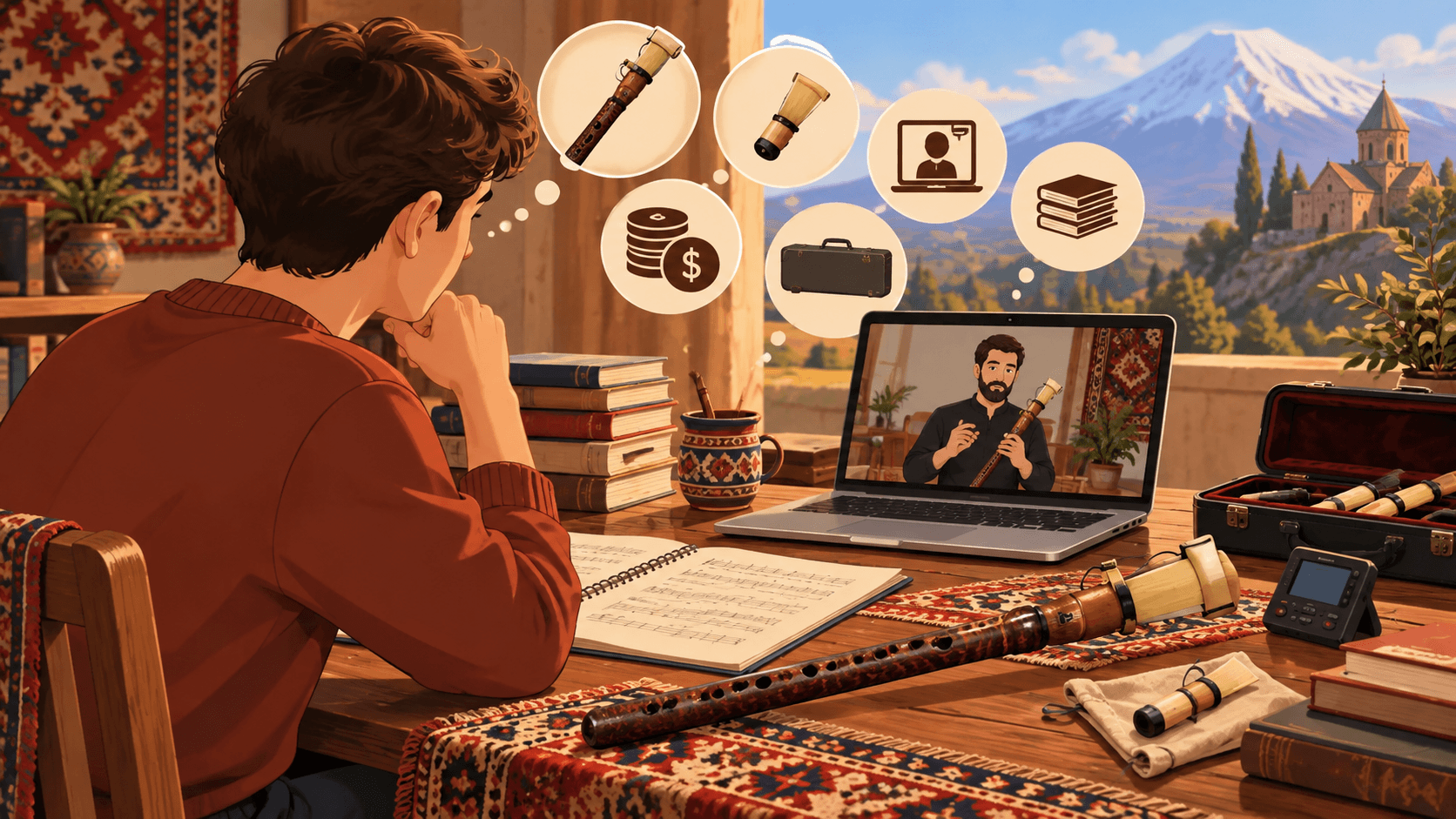
Your total beginner budget can include:
- Your first duduk
- A properly matched reed
- Private lessons
- Online or recorded courses
- Learning books
- Sheet music
- A protective case
- A tuner or metronome
- Replacement reeds over time
The good news is that learning duduk does not require buying everything at once.
Some students begin with a suitable beginner instrument and free learning resources. Others prefer regular private instruction from the first week. Experienced musicians may invest immediately in a professional handmade duduk.
The right budget therefore depends on how you want to learn, what instrument you choose, and how much individual instruction you need.
In this guide, we break down the real costs involved so that you can plan your duduk journey without unnecessary purchases.
If you are still looking for someone to teach you, start with our guide Where Can I Find a Duduk Instructor Near Me?.
If you are completely new to the instrument itself, explore the educational resources available on the Duduk Rocks Blog before making your first purchase.
Quick Answer: How Much Does Learning Duduk Cost?
There is no universal fixed price.
As of 2026, private duduk lessons available online show considerable variation depending on teacher, platform, lesson duration, and program structure.
For example, some specialized music schools offer packages that work out to approximately 40–75 CAD per lesson, depending on lesson length and commitment.
Other marketplaces list specialist instructors at substantially higher individual rates.
Monthly academy-style programs can also cost several hundred dollars depending on how often private lessons are included.
Then there is the instrument itself.
At Duduk Rocks, current beginner and student instruments demonstrate the kind of starting investment students may encounter:
| Item | Example Current Price |
|---|---|
| Beginner Quality Duduk in A | €179 |
| Student Quality Duduk in A | €299 |
| MKS Professional Duduk in A | €369 |
| Premium Duduk Reed | €66 |
| Beginner Learning Course | €49 |
| Complete Beginner Guide | €64.99 |
Prices can change, so always check current listings before purchasing.
You can browse current duduk prices at Duduk Rocks.
What Are You Actually Paying For When Learning Duduk?
When people ask about the cost of learning an instrument, they often focus only on lessons.
But with the duduk, it is more useful to divide the budget into several categories.
Your total investment generally includes:
1. The Duduk
This is the most important initial purchase.
2. The Reed
The reed is fundamental to sound production and playability.
3. Lessons
Private instruction can become your largest recurring expense.
4. Learning Materials
Books, courses, exercises, and sheet music can supplement instruction.
5. Accessories
Cases and practice tools may improve convenience and protect your instrument.
Understanding these categories makes it much easier to determine what you actually need at the beginning.
How Much Does a Beginner Duduk Cost?
The price of a duduk varies significantly.
You can find extremely inexpensive instruments online, but price alone does not tell you whether an instrument is suitable for serious learning.
A beginner needs an instrument that:
- Plays reliably
- Has usable intonation
- Works properly with its reed
- Responds consistently
- Allows correct technique to develop
This matters more than purchasing the cheapest possible object that looks like a duduk.
At the time of writing, the Duduk Rocks Shop lists a Beginner Quality Duduk in A at approximately €179.
A Student Quality Duduk in A is listed at approximately €299.
Professional instruments from established makers can begin around the €300–€400 range and rise considerably depending on maker, wood, construction, rarity, and design.
For example, professional MKS Karen Mukayelyan instruments are currently offered around €369 for several standard models.
More specialized or exotic-wood instruments can cost much more.
Do Beginners Need a Professional Duduk?
Not necessarily.
A complete beginner does not automatically need the most expensive instrument available.
However, there is an important difference between not needing a premium professional instrument and using an instrument that is difficult or impossible to play properly.
A suitable beginner duduk should still provide:
- Stable construction
- Reasonable tuning
- Appropriate finger-hole positioning
- A functional reed
- Predictable response
A poor instrument can create a frustrating situation.
You may think:
“I cannot produce a good sound because I am a beginner.”
But sometimes the real problem is the instrument or reed.
This is why choosing an instrument designed for genuine learning can save both time and money.
For a deeper understanding of what separates a properly made instrument from a decorative one, read our guide to Armenian Duduk Craftsmanship.
How Much Does a Professional Duduk Cost?
Professional duduks vary enormously in price.
At Duduk Rocks, many professional instruments currently fall into the €300–€500 range, while specialized instruments made from premium or unusual woods can cost significantly more.
Examples currently available include professional instruments by makers such as:
- Karen Mukayelyan
- Sevada Iritsyan
- Sahak Gasparyan
- Other specialist makers
Certain exotic-wood instruments can reach approximately €1,000 or more.
This does not mean that every student should spend that amount.
Professional instruments are generally most relevant when:
- You already know you want to continue playing
- You require better performance consistency
- You record professionally
- You perform publicly
- You need particular tuning or tonal characteristics
- You want an instrument from a particular maker
Beginners can explore available options directly in the Duduk Rocks Shop.
How Much Does a Duduk Reed Cost?
The reed is one of the most important parts of your budget.
A duduk body without a suitable reed is not enough.
At Duduk Rocks, premium reeds for several common duduk keys are currently listed at approximately €66 each.
That includes reeds for instruments in:
- A
- B♭
- C
- D
- F
- G
You can explore the full collection through the Duduk Rocks Shop.
Why the Reed Should Not Be an Afterthought
For beginners, the reed can have an enormous effect on the learning experience.
The reed determines how air enters the instrument and strongly influences resistance and response.
A reed that is unsuitable, damaged, or incorrectly adjusted can make basic tone production unnecessarily difficult.
This creates one of the most common beginner problems:
You cannot tell whether the difficulty comes from you or the equipment.
A good teacher can often help identify the difference.
That is one reason it is useful to begin lessons with a properly functioning reed.
If you want to understand this component before purchasing, explore the reed-related guides available on the Duduk Rocks Blog.
How Much Do Private Duduk Lessons Cost?
This is where the largest variation usually appears.
Duduk teachers are relatively specialized compared with piano or guitar teachers, and lesson rates depend heavily on location and experience.
Current online listings in 2026 demonstrate this range clearly.
One music academy currently offers:
- Four 30-minute lessons for 160 CAD
- Four 45-minute lessons for 230 CAD
- Four 60-minute lessons for 300 CAD
That works out to approximately:
- 40 CAD per 30-minute lesson
- 57.50 CAD per 45-minute lesson
- 75 CAD per 60-minute lesson
Longer commitments may include package discounts.
Other online teaching platforms currently list individual duduk instructors at considerably different rates.
This is why you should not rely on one universal figure such as “duduk lessons cost $40.”
There is no single market price.
Why Can Duduk Lesson Prices Vary So Much?
Several factors influence the cost.
Teacher Experience
An established professional performer with decades of experience may charge more than a newer teacher.
Lesson Length
A 60-minute private lesson generally costs more than a 30-minute session.
Standort
In-person teaching costs vary according to country and city.
Individual vs Group Instruction
One-to-one teaching is generally more expensive because the entire lesson is dedicated to one student.
Teacher Reputation
Teachers with major performance careers, specialist knowledge, or high demand may charge higher rates.
Package Structure
Some teachers sell individual sessions.
Others offer monthly, quarterly, or annual programs.
Comparing only the advertised price can therefore be misleading.
Always check how many lessons you actually receive.
What Does a Duduk Lesson Usually Include?
You are not simply paying someone to show you which holes to cover.
A good instructor can help with areas such as:
- Posture
- Hand position
- Embouchure
- Breath control
- Tone production
- Finger technique
- Intonation
- Articulation
- Reed setup
- Traditional repertoire
- Ornamentation
- Phrasing
- Circular breathing at more advanced levels
Most importantly, an instructor provides feedback.
A video can demonstrate how something should be done.
A teacher can tell you why you are not getting the expected result.
That difference explains much of the value of private instruction.
How Often Should You Pay for Duduk Lessons?
You do not necessarily need multiple lessons every week.
For many beginners, one lesson per week provides a practical balance between instruction and independent practice.
You learn something during the lesson, practice it during the week, and return for correction.
Another option is a lesson every two weeks.
This can reduce monthly costs while still providing regular professional feedback.
Some academies specifically offer both weekly and biweekly learning tracks.
The right frequency depends on:
- Your budget
- Practice time
- Musical experience
- Goals
- Teacher availability
A student practicing consistently between lessons may benefit significantly even from less frequent instruction.
Weekly vs Biweekly Duduk Lessons
Suppose your teacher charges the equivalent of $50 per lesson.
Weekly lessons would cost roughly:
4 lessons × $50 = $200 per month
Biweekly lessons would cost roughly:
2 lessons × $50 = $100 per month
Over one year, that difference becomes significant.
This is why lesson frequency is one of the easiest ways to control your overall learning budget.
A beginner who cannot afford weekly lessons does not need to abandon private instruction entirely.
A combination of:
occasional private lessons + structured self-practice + free resources
can be a very effective approach.
Can You Learn Duduk for Free?
You can begin learning many aspects of the duduk without paying for regular courses.
Duduk Rocks currently provides free educational video resources designed around traditional duduk learning material.
The site specifically offers free tutorial videos based on the Armenische Duduk-Methode von Georgy Minasyan, featuring duduk player Gagik Hakobyan.
This means your learning budget does not necessarily need to include weekly paid instruction from the beginning.
You might use:
- Free video tutorials
- Fingering exercises
- Listening practice
- Educational articles
- Occasional private lessons
This can dramatically reduce the ongoing cost.
Visit Duduk Rocks and the Duduk Rocks Blog to explore educational content.
Free Resources vs Paid Duduk Lessons
Free resources are extremely useful.
But they do not completely replace individual feedback.
A video does not know whether:
- Your finger is leaking air
- Your reed is too closed
- Your lips are too tense
- Your breathing is unstable
- Your pitch is incorrect
That is where occasional private instruction becomes especially valuable.
One cost-effective approach is:
Step 1
Learn the basic concepts through free material.
Step 2
Practice independently.
Step 3
Book a private lesson.
Step 4
Ask the instructor to identify your major technical problems.
Step 5
Return to independent practice.
Step 6
Book another lesson when you need additional correction.
You therefore receive expert feedback without paying for constant instruction.
How Much Do Duduk Learning Books Cost?
Learning books can be a relatively inexpensive addition to your budget.
Duduk Rocks currently lists resources such as:
Armenian Duduk Method by Georgy Minasyan — approximately €57.99
Other learning materials are also available.
For example, a beginner-oriented educational course is currently listed around €49, while a complete beginner guide is offered around €64.99.
Books and structured courses can be particularly useful for students who prefer organized progression.
You can find current educational materials in the Duduk Rocks Shop.
Do You Need to Buy Sheet Music?
Not necessarily.
Some duduk teaching traditions rely significantly on listening, imitation, and learning melodies by ear.
Other teachers use written notation more extensively.
Your need for sheet music therefore depends on:
- Your instructor
- Your learning style
- Your repertoire
- Your existing music-reading ability
Students interested in particular Armenian repertoire may eventually want specialized collections.
At Duduk Rocks, for example, educational products currently include an Armenian duduk songbook associated with Gevorg Dabaghyan as well as Armenian Komitas material for duduk with piano accompaniment.
These are optional learning resources rather than mandatory first-day expenses.
Do You Need a Duduk Case?
A protective case or bag is highly recommended.
A duduk is made from wood, and the reed is especially delicate.
A case protects your equipment during:
- Transportation
- Storage
- Lessons
- Travel
Current Duduk Rocks protective options range from simple bags to larger multi-instrument cases.
This is an example of an expense that may not improve your playing directly but can help protect the money you have already invested in your instrument.
Do You Need a Tuner?
A tuner can be useful, especially when developing awareness of intonation.
However, you do not necessarily need to purchase a dedicated electronic tuner.
Many musicians use software or mobile applications for basic pitch reference.
Your instructor may also recommend practicing certain notes with a drone or reference pitch.
The important skill is eventually learning to hear whether you are in tune rather than becoming completely dependent on a visual display.
Do You Need a Metronome?
A metronome is useful for rhythmic practice.
Again, this does not have to become a significant expense.
The purpose is simply to provide a stable pulse while practicing:
- Scales
- Finger exercises
- Articulation
- Melodies
- Rhythmic patterns
It is helpful but not an essential expensive purchase.
Beginner Duduk Budget: The Low-Cost Approach
Suppose your objective is to begin seriously without spending heavily on private instruction.
A basic budget might include:
Instrument
Beginner duduk: approximately €179
Mundstück
Depending on what is included with your instrument and what you choose, you may eventually budget for a quality additional reed.
Educational Resources
Use free tutorials and guides initially.
Lessons
Take occasional private sessions rather than weekly instruction.
This approach keeps your starting investment relatively controlled.
The largest expense becomes your instrument, while ongoing educational costs can remain flexible.
Beginner Duduk Budget: The Structured Approach
A student who wants more guidance might choose:
- A suitable beginner or student duduk
- A good reed
- Weekly or biweekly lessons
- One structured learning book or course
For example:
Instrument
€179–€299
Mundstück
Around €66 for a premium reed if needed separately
Learning Resource
Approximately €49–€65
Lessons
Variable according to teacher and frequency
The instrument and learning materials are mainly upfront expenses.
Lessons become the principal recurring cost.
Beginner Duduk Budget: The Professional Approach
Some students already know that they are serious about the instrument.
Perhaps they are professional musicians who play another woodwind instrument.
They may prefer to begin with:
- A professional handmade duduk
- Premium reed
- Individual instruction
- Structured educational resources
- Protective case
- Additional reeds
In this situation, the initial investment can easily exceed several hundred euros before lessons are included.
This approach makes sense for some musicians—but it is not required simply to discover whether you enjoy playing duduk.
Example First-Year Duduk Budget
Imagine a student purchases:
- Beginner Duduk: €179
- Premium additional reed: €66
- Beginner course: €49
That produces an initial equipment and learning-material cost of approximately:
€294
Lessons would then be added according to the student’s chosen teacher.
The important thing is that you do not necessarily repeat those instrument costs every month.
Once you have a suitable duduk, your main ongoing costs are generally:
- Lessons
- Occasional reeds
- Optional new learning materials
This makes the long-term budget easier to manage than the initial purchase may suggest.
Is It Cheaper to Learn Duduk Online?
Potentially.
Online instruction can remove costs associated with:
- Transportation
- Travel time
- Parking
- Geographic scarcity
But online does not automatically mean inexpensive.
Some internationally recognized specialists may charge premium rates.
The greatest financial advantage of online learning is therefore not necessarily a lower hourly rate.
It is choice.
You can compare teachers across different countries and choose the combination of experience, teaching style, schedule, and price that works for you.
For help choosing between local and online instruction, read Where Can I Find a Duduk Instructor Near Me?.
Is It Cheaper to Teach Yourself?
Yes, at least financially.
But there is a trade-off.
Self-learning reduces lesson expenses while increasing the risk of spending time developing incorrect habits.
Possible problems include:
- Poor embouchure
- Incorrect breathing
- Bad finger position
- Reed problems
- Unstable intonation
- Excessive tension
A useful compromise is to combine self-study with occasional professional feedback.
This allows you to control expenses without learning completely alone.
How to Save Money While Learning Duduk
There are several sensible ways to reduce the cost without damaging your learning experience.
Start With Free Resources
Before purchasing multiple courses, use reputable free tutorials.
Buy One Suitable Instrument
Avoid buying several extremely cheap duduks hoping that one will work.
One reliable learning instrument is more useful than several decorative instruments.
Ask Your Teacher Before Buying
A teacher may help prevent an unnecessary or inappropriate purchase.
Use Lessons Strategically
You do not necessarily need weekly lessons forever.
Practice Between Sessions
Paying for lessons without practicing wastes the value of the instruction.
Protect Your Reed
Proper handling can help prevent unnecessary damage.
Upgrade Only When Necessary
Do not assume that a more expensive instrument will automatically solve a technical problem.
The Hidden Cost of Buying the Wrong Duduk
One of the easiest ways to waste money is to buy an inappropriate first instrument.
An extremely inexpensive duduk may look attractive because it reduces your initial cost.
But if it has:
- Poor intonation
- Incorrect bore dimensions
- Weak construction
- An unusable reed
- Inconsistent response
you may eventually replace it.
The result can be:
cheap instrument + replacement instrument = more money spent
There is also another cost:
lost motivation.
A beginner who cannot produce the expected sound may incorrectly believe that they simply cannot play duduk.
A properly functioning instrument gives you a fair opportunity to develop technique.
Should You Buy Used?
A used duduk can potentially reduce the price.
However, beginners should be cautious because they may not yet know how to evaluate:
- Condition
- Tuning
- Cracks
- Previous repairs
- Bore quality
- Reed condition
If you buy used, it can be helpful to have an experienced musician inspect the instrument.
Remember that reeds are particularly personal and sensitive components, so you may still want your own properly selected reed.
When Should You Upgrade Your Duduk?
There is no fixed timeline.
Upgrade when your current instrument begins to limit a genuine musical need.
Possible reasons include:
- You need more consistent intonation
- You are beginning professional recording
- You perform regularly
- You require another key
- You want a particular maker
- You need a specific tonal character
- Your teacher recommends a more advanced instrument
Do not upgrade simply because you have reached a particular number of months.
Musical development is more important than a calendar.
Should You Buy Duduks in Multiple Keys?
Not when you are just beginning.
One suitable instrument is enough to establish:
- Tone
- Fingering
- Breathing
- Intonation
- Basic repertoire
Later, advanced players may own several instruments in different keys to accommodate different musical situations.
But purchasing multiple duduks immediately increases your starting cost without necessarily improving your basic technique.
Is Learning Duduk More Expensive Than Learning Other Instruments?
There is no simple universal answer.
The duduk itself can be relatively accessible compared with certain professional orchestral instruments.
However, specialist teachers may be harder to find.
That means instruction can represent a significant portion of the total cost.
On the positive side, you generally do not need:
- Large amplification systems
- Expensive electronic equipment
- Complex maintenance equipment
- Large amounts of physical space
Your core setup remains relatively simple:
duduk + reed + instruction + practice
The Most Important Investment Is Not Money
A useful instrument and a good teacher matter.
But neither replaces practice.
A student can spend thousands on instruments and lessons and still make limited progress without consistent practice.
Another student may begin with a modest instrument, carefully use free resources, take occasional lessons, and develop steadily.
The most important investment is therefore:
time spent practicing correctly.
Money can give you better resources.
Practice turns those resources into musical ability.
Frequently Asked Questions
How much does it cost to start learning duduk?
The initial cost depends primarily on your instrument and learning approach. Current Duduk Rocks pricing includes beginner instruments around €179, with more advanced student and professional models costing more. Private lessons are an additional recurring expense.
How much do duduk lessons cost?
Prices vary substantially. Current online examples range from roughly 40 CAD for some 30-minute lessons to substantially higher rates from specialist instructors. Always check current prices before booking.
How much does a beginner duduk cost?
At the time of writing, Duduk Rocks lists a Beginner Quality Duduk in A at approximately €179.
You can check current duduk prices here.
Do I need an expensive duduk to learn?
No. Beginners do not require the most expensive professional instrument, but they should use a properly functioning duduk with reasonable tuning and response.
Do I need to buy a reed separately?
It depends on the product or set you purchase. Always check exactly what is included. Having a properly matched, playable reed is essential.
How much does a duduk reed cost?
Premium reeds currently listed at Duduk Rocks are around €66, although prices vary depending on maker, key, and type.
Can I learn duduk for free?
You can learn many fundamentals using free resources. Duduk Rocks provides free educational material, and students can combine self-study with occasional lessons.
Are online duduk lessons cheaper?
Sometimes, but not always. The main advantage of online learning is access to a wider selection of specialist teachers.
How often should beginners take lessons?
Weekly lessons can provide consistent guidance, but biweekly or occasional lessons can also work well when combined with regular independent practice.
Is one duduk enough for a beginner?
Yes. Beginners generally do not need multiple keys. Start with one suitable instrument and develop your fundamentals before expanding your collection.
Should I buy a professional duduk immediately?
Only if it fits your goals and budget. Many beginners can start successfully with a quality beginner or student instrument.
What is the cheapest effective way to learn duduk?
A cost-conscious approach is to purchase one reliable beginner instrument, use free educational resources, practice consistently, and book occasional private lessons for feedback.
How to Build Your Duduk Budget
Before purchasing anything, divide your budget into three categories.
Essential
- Duduk
- Functional reed
Highly Recommended
- Instruction or periodic teacher feedback
- Protective storage
Optional
- Additional reeds
- Books
- Courses
- Sheet music
- Additional duduks
- Premium cases
- Multiple keys
This prevents you from spending too much on accessories before you have even learned to produce a stable tone.
Start With the Right Duduk
If you are ready to begin learning, your first priority should be an instrument that allows you to practice correctly.
You can explore the complete Duduk Rocks Shop to compare beginner, student, and professional instruments.
Duduk Rocks offers instruments from established Armenian makers alongside reeds, learning materials, cases, and other resources for musicians.
You can also visit Duduk Rocks for more information about the instrument and its craftsmanship.
Continue Your Duduk Learning Journey
Cost is only one part of choosing how to learn.
Before beginning, it is equally important to understand the instrument, find the right teacher, and know what to expect from your first lessons.
Continue with:
- Where Can I Find a Duduk Instructor Near Me?
- Duduk Musical Instrument
- Armenian Duduk
- Armenian Duduk Craftsmanship
For more guides about reeds, musicians, makers, playing techniques, history, and Armenian musical culture, explore the Duduk Rocks Blog.
Fazit
So, how much does it cost to learn duduk?
There is no single number.
A beginner can start relatively simply with one reliable instrument and free educational resources, while another student may choose a professional handmade duduk and weekly private instruction from an established teacher.
Your total cost is determined by four main decisions:
the instrument you buy, the reed you use, how frequently you take lessons, and how many additional learning resources you purchase.
At current Duduk Rocks pricing, a beginner instrument can start around €179, while student and professional instruments move upward from there.
Private lesson prices vary widely, which makes instructor selection and lesson frequency the biggest variables in your long-term budget.
You do not need the most expensive setup to begin.
You need a duduk that functions properly, a suitable reed, good information, and enough feedback to prevent incorrect habits.
Start with the essentials.
Practice consistently.
Add private instruction when you need guidance.
Upgrade your equipment when your musical development genuinely requires it.
If you are ready to begin, browse duduks, reeds, learning materials, and accessories at Duduk Rocks.
And if you still need someone to guide your first notes, continue with Where Can I Find a Duduk Instructor Near Me?.
Learning the duduk is an investment—but the most important investment is not the price of the instrument.
It is the time you spend learning how to give it a voice.